
India is one of the largest producers as well as consumers of rice in the world, and that fact makes the rice flour machine one of the most dependable agro-based businesses you can start. Earlier, traditional households mainly used rice flour, but today gluten-free diets, packaged foods, ready mixes, bakery products, snacks, and baby food products are increasing in demand. Restaurants, sweet shops, and food manufacturers are now large buyers, not just homes.
A rice flour unit is no longer just a small village setup; it is becoming a structured commercial industry. With proper planning, it can generate steady monthly revenue with consistent demand throughout the year.
Here, we share complete information that will help you to start your own rice flour mill efficiently and successfully.
What is a Rice Flour Mill Machine?
A rice flour mill machine is designed to create raw rice into fine, high-quality flour. It removes the coat of husk and bran from the paddy and grinds the rice into smooth, uniform rice flour that can be good for cooking or further processing. Modern machines can produce large volumes efficiently and maintain uniform flour quality for an ideal business.
The small-scale, semi-automatic, and fully automatic rice mill machines are available depending on your target market: household, semi-industrial, or packaged food.
Which Machines Are Required for a Rice Flour Mill?
To ensure smooth operations in a rice flour mill, you need different types of rice flour machines:
- Rice Cleaner – It removes all the impurities like stones, dust, and husk.
- Rice Polisher – Polishes every rice grain to produce high-quality flour.
- Rice Grinder / Pulverizer – It grinds polished rice into a fine flour.
- Sifter / Flour Separator – Maintain a uniform size of flour particles.
- Packing Machine – Fill the flour in bags or pouches and pack them for sale either in retail or bulk.
You can also install equipment such as dryers, silos, and automated conveyors to improve efficiency and reduce labor costs.
What Is the Cost of a Rice Flour Mill in India?
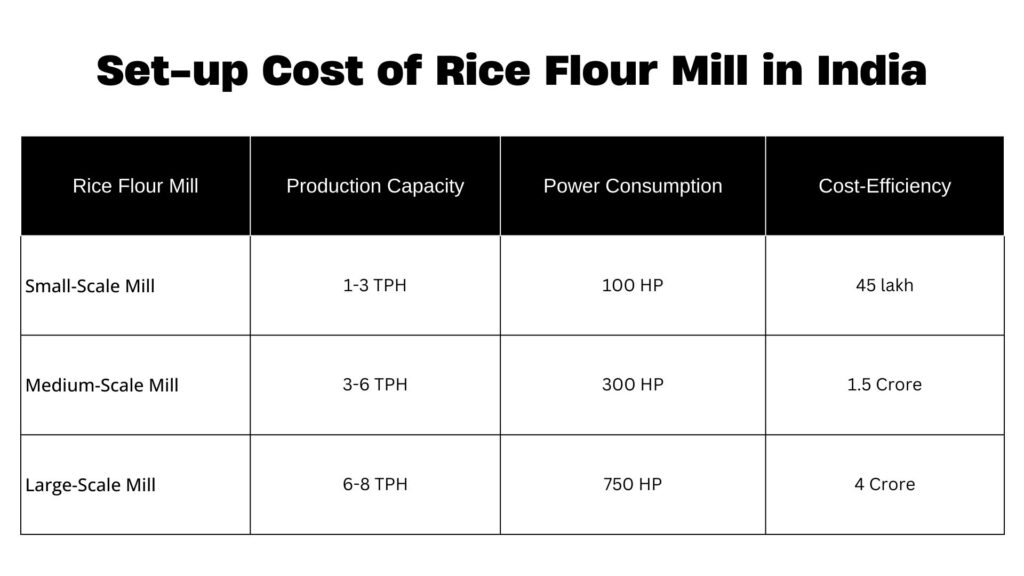
The price varies according to the size, manufacturing potential and the automation of the mill. Here’s a rough estimate:
- Small Scale Mill: To commence Small Scale rice mill, the approximate cost is ₹45 lakh.
- Medium-Scale Mill: In the case of medium scale rice mill, the approximate price is ₹1.5 Crore.
- Commercial / Large-Scale Mill: To start a commercial/large-scale rice mill, the approximate cost is ₹4 crore.
Note: The total rice mill investment includes land, electricity, storage, working capital, and other costs. Proper planning ensures success.
What Production Capacity is Needed for a Rice Flour Mill?
Production capacity depends on your target market and investment size:
- Small-Scale: Ideal for local homes or small restaurants, with a capacity of 1–3 TPH.
- Medium-Scale: For medium enterprises or Regional distribution and bakeries, a 3-6 TPH capacity is required.
- Large-Scale: When you serve large-scale industrial clients, packaged food brands, and bulk buyers, you need a capacity of 6–8 tons per day.
Choosing the right production capacity helps you meet market demand efficiently while avoiding unnecessary investment in machinery.
How Much Energy and Power is Needed for a Rice Flour Plant?
A rice flour mill consumes electricity depending on its machinery and capacity:
- Small Mill: 100 HP
- Medium Mill: 300 HP
- Large Mill: 750 HP
Power requirements also include lighting, conveyors, and optional drying machines. Energy-efficient machinery can significantly reduce operating costs.
Which Licenses and Registrations Are Required?
When you plan to operate a rice flour mill in India legally, you have to apply for the following licenses.
- Business Registration – If you want to plan a rice mill, you have to Proprietorship, Partnership, LLP, or Pvt Ltd.
- GST Registration – GST Registration is mandatory for taxation and B2B businesses.
- Food License (FSSAI) – Ensures you have a proper license from FSSAI that meets food safety standards.
- Pollution Control Clearance – You must obtain Pollution Control Clearance for large-scale mills in some states.
- Trade License / Shop & Establishment License – Trade licenses are required for Local municipal compliance.
While you receive the required licenses, you must consult with local authorities to ensure their validity before commencing operations.
Final Thoughts
Establishing a rice flour mill in India can be truly profitable. The demand is rising for the rice mill due to health prevention, packaged foods, and commercial use, making it a stable business opportunity.
By choosing the right rice mill machinery, scale, and location, and by ensuring compliance with the proper licenses, you can build a rice flour business that makes consistent income year-round.
In case you need rice flour mill equipment and professional help, contact Flourtech Engineers. We have experience in business setup.

