
Walk into two flour mills in India, and you may find that both are processing wheat, and yet their cleaning sections are not configured the same.
That is not necessarily a difference in technology. More often, it comes down to the wheat coming into the plant.
One mill may regularly receive relatively clean wheat from a known source. Another may handle wheat with more straw, dust, stones, or other foreign material. A third may work with different varieties or blends depending on customer requirements.
This is why selecting a wheat cleaning machine is not simply about asking, “Which machine is the best?”
The more useful question is:
What does this machine separate, what does it remove, and where does it fit into the overall cleaning process?
Once that is clear, a mill owner, plant manager, or new team member can easily understand why the team configured a particular cleaning section in that way.
And there is another point that often confuses.
The basic wheat cleaning process is broadly similar whether the final product is household chakki atta, tandoori atta, or maida. The major difference comes later, in how deeply the cleaned wheat is processed.
Household chakki atta generally retains more bran. Tandoori atta has a different level of bran retention, while maida requires much greater bran removal and refinement.
So, cleaning and refinement should be looked at as two related but separate decisions.
Cleaning prepares the wheat. Refinement determines how far the mill processes that wheat for the final product.
With that distinction in mind, let’s look at the cleaning process from the point of view of the machines themselves.
Understanding the Wheat Cleaning Machine used in each section
A cleaning section does not rely on one wheat cleaning machine to remove everything.
Different machines work on different physical properties of the material. Primarily size, density, weight, shape, surface characteristics, and magnetism.
The overall process can be divided into three sections:
1. Pre-Cleaning Section
Drum Sieve → Pre-cleaner
2. 1st Cleaning Section
Vibro Separator / Rotary Separator → Destoner / Gravity Separator → Scourer
3. 2nd Cleaning Section
Vibro Separator / Rotary Separator → Destoner / Gravity Separator → Scourer → Cockle Cylinder → Magnetic Separator
The cleaning process runs through both the 1st and 2nd Cleaning Sections, with dampening between them. The first cleaning stage removes larger and remaining impurities, while the second cleaning stage provides another pass for finer and remaining impurities.
The exact configuration can vary with wheat condition, plant capacity, and the miller’s experience with the particular raw material.
Rather than looking at this as one long list of machines, it is easier to understand what each wheat cleaning machine contributes to the overall process.
1. Pre-Cleaning Section
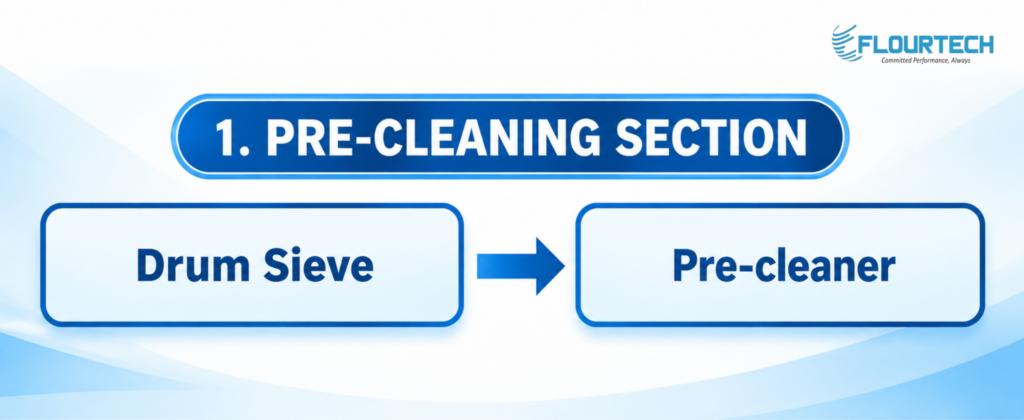
The pre-cleaning section is where the wheat first encounters dedicated cleaning equipment.
Its job is relatively straightforward: remove the larger, more obvious foreign material before the wheat moves into the more detailed cleaning stages.
Drum Sieve
| Separation Basis | Target |
| Size | Remove large foreign material such as oversized straw, sticks, and other coarse impurities. |
How It Works
Wheat passes through a rotating perforated drum. The openings allow wheat and smaller material to pass through, while larger objects remain inside the drum and are discharged separately.
Typical Usage Pattern
Drum sieves are commonly used around intake as an initial coarse-screening stage. Some millers who are confident about their wheat source and condition may use only one of the initial coarse-cleaning stages rather than both the drum sieve and pre-cleaner.
The purpose at this stage is to remove the large material before it travels deeper into the cleaning line.
Pre-cleaner
| Separation Basis | Target |
| Size and screening characteristics | Remove large, easily separable non-wheat material and coarse impurities. |
How It Works
Wheat passes over screening surfaces with defined openings. Material that is too large or otherwise unsuitable for the wheat stream is separated, while the wheat continues forward.
Typical Usage Pattern
Pre-cleaners are commonly used around intake to remove coarse impurities before the wheat reaches subsequent cleaning stages. Depending on the incoming wheat and plant configuration, some millers may use a pre-cleaner as their primary initial screening stage.
The drum sieve and pre-cleaner therefore perform related early-stage functions, but their actual use can vary depending on the wheat source and its condition.
2. 1st Cleaning Section
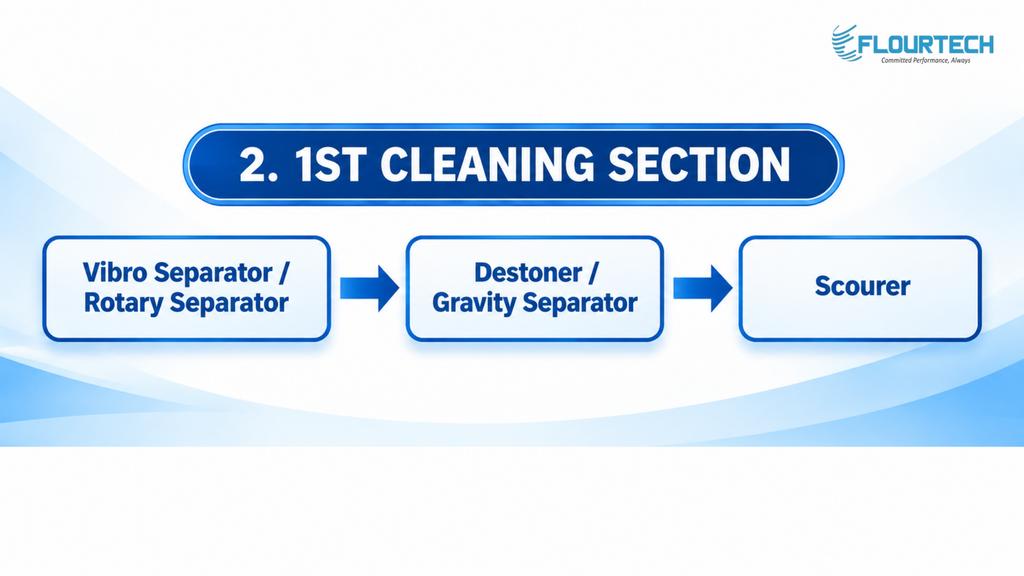
After pre-cleaning, the wheat enters the first detailed cleaning stage.
Here, the separation becomes more specific. Instead of simply removing large objects, the wheat cleaning machine begins working on impurities that are closer to wheat in size or require a different physical principle for separation.
The section follows this sequence:
Vibro Separator / Rotary Separator → Destoner / Gravity Separator → Scourer
Vibro Separator
| Separation Basis | Target |
| Size and vibrating motion | Smaller impurities that differ from wheat in size and screening behaviour. |
How It Works: The screening surface moves in a linear motion, keeping the wheat moving across the screens while allowing appropriately sized material to separate.
Typical Usage Pattern: Vibro separators are used in wheat cleaning sections where screening through vibrating motion forms part of the cleaning approach.
Rotary Separator
| Separation Basis | Target |
| Size and rotary motion | Smaller impurities that differ from wheat in size and screening behaviour. |
How It Works: The machine uses rotary movement to move material through its screening surfaces. Its multi-directional filtering action can remove a higher volume of impurities when operated with the appropriate strategy by a qualified miller.
Typical Usage Pattern: Rotary separators support wheat cleaning sections where rotary movement and multi-directional screening are part of the operating approach.
Vibro Separator vs Rotary Separator
| Feature | Vibro Separator | Rotary Separator |
| Screening Action | Uses controlled vibratory motion to move wheat across the screening decks | Uses rotary movement to carry wheat through the screening system |
| Material Movement | Wheat moves across the screening surface through vibration | Wheat moves through the screening system through rotary action |
| Effect on Operation | Vibratory motion influences material distribution and screening behaviour | Rotary motion influences material distribution and screening behaviour |
| Key Difference | Vibratory screening action in linear motion | Rotary screening action in rotary motion |
Understanding this difference is essential in selecting the relevant wheat cleaning machine for removal of small impurities in a flour mill or atta chakki plant.
Destoner
| Separation Basis | Target |
| Density and weight | Stones, mudballs, and other heavy contaminants. |
How It Works: Controlled airflow and movement across a separating surface cause heavy particles to behave differently from wheat. The difference in density allows heavy material to separate from the wheat stream.
Once that is clear, a mill owner, plant manager, or new team member can easily understand why the team configured a particular cleaning section in that way.
Gravity Separator
| Separation Basis | Target |
| Weight and density | Heavy and light particles within the wheat stream, including material that differs from sound wheat in density. It is also commonly used for germ separation. |
How It Works: Wheat moves across a separating surface under controlled airflow. Differences in density affect how individual particles behave, allowing heavier and lighter material to separate.
Typical Usage Pattern: Millers use gravity separators based on their preferences and desired quality-improvement goals. Many millers prefer them for the quality improvement they can provide, particularly where density-based separation is useful.
Destoner vs Gravity Separator
| Feature | Destoner | Gravity Separator |
| Separation Principle | Density + weight | Density + weight |
| Primary Purpose | Removes heavy impurities from input wheat | Separates wheat based on weight and impurities |
| Typical Targets | Stones, mudballs, heavy impurities | Heavy/light wheat kernels and density-differentiated impurities |
| Key Difference | Separation of heavy impurities | Separation for impurities as well as heavy and light wheat |
Understanding this difference is essential in selecting the relevant wheat cleaning machine for removal of stones and different impurities in a flour mill or atta chakki plant.
Scourer
| Separation Basis | Target |
| Mechanical surface action and controlled impact/friction | Surface dirt and material stuck to the outer surface of the wheat. |
How It Works
Wheat passes through a controlled mechanical scouring action. The intensity is influenced by several machine and operating parameters, including:
- Beater configuration
- Scouring mode settings
- Rotor calibration
- Screen jacket type
Scouring intensity is therefore not simply a matter of changing feed rate or rotor speed.
Typical Usage Pattern
Scourers are incorporated according to the cleaning configuration and the required level of surface cleaning. In larger roller flour mills, debranning and scouring become particularly relevant where the process is designed for refined flour production.
3. 2nd Cleaning Section
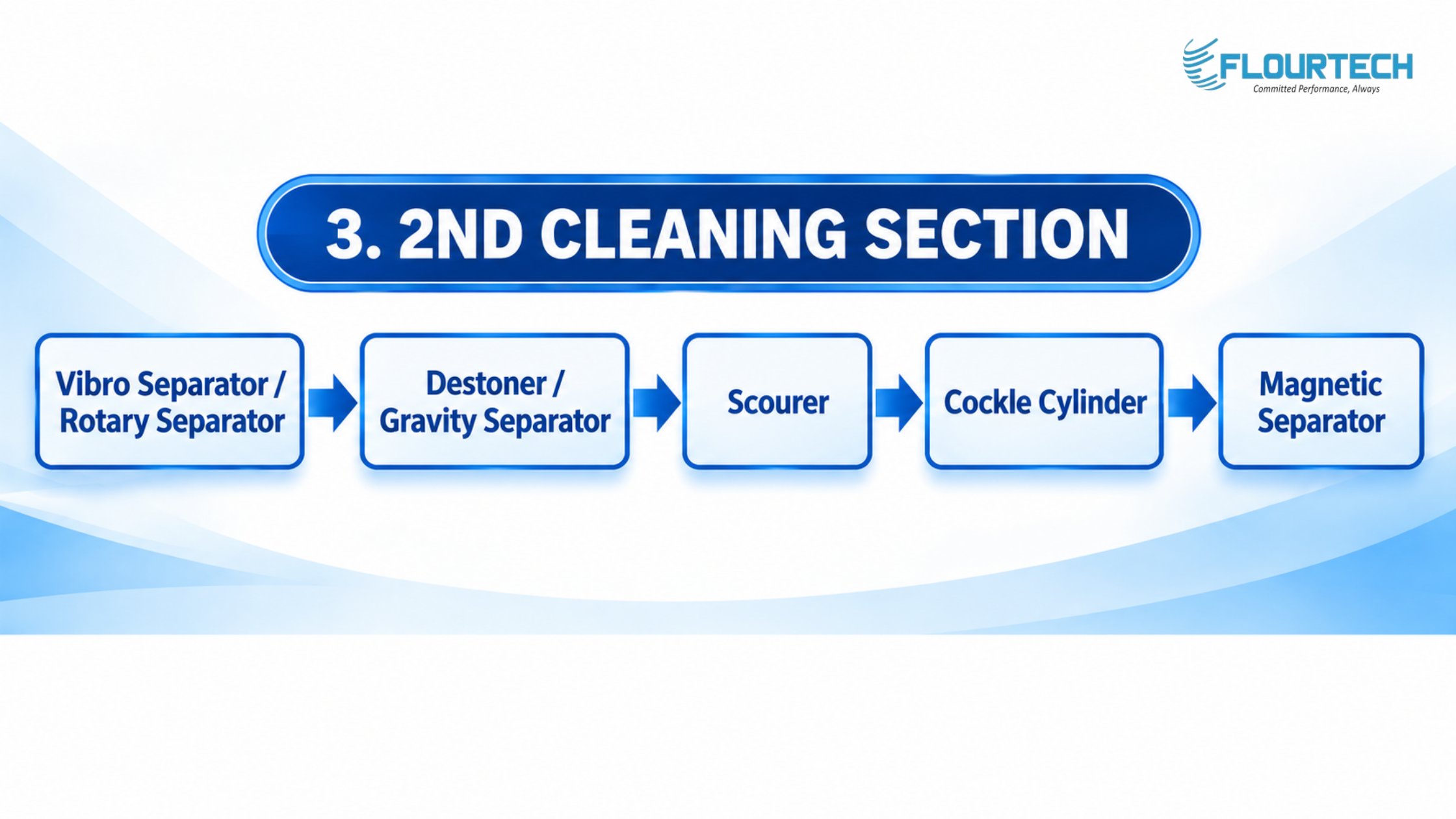
After the first cleaning section and the intervening dampening stage, the wheat enters the 2nd Cleaning Section.
The sequence is:
Vibro Separator / Rotary Separator → Destoner / Gravity Separator → Scourer → Cockle Cylinder → Magnetic Separator
The first three stages use the same broad separation principles already described in the 1st cleaning section. Their role in the 2nd Cleaning Section is to provide another cleaning pass for remaining impurities rather than introducing a completely different wheat cleaning machine concept.
The section then moves to two more specific forms of separation: shape/length separation through the cockle cylinder and magnetic separation through the magnetic separator.
Cockle Cylinder
Some impurities can remain difficult to separate because their size or density is relatively close to wheat. Their shape and length, however, can be different.
This is where the cockle cylinder comes into the process.
| Separation Basis | Target |
| Shape and length, using rotation and gravity with a centrifugal element | Round or oblong impurities and broken grains that differ in shape or length from sound wheat kernels, like Cockle and other weed seeds, Broken kernels, and Shrunken kernels. |
How It Works
The machine consists of a rotating cylinder with indented pockets on its inner surface.
As the cylinder rotates, its indents pick up shorter or rounder particles, while longer wheat kernels do not settle into them as easily.
The cylinder then lifts the picked-up particles as it rotates. At a certain point in the rotation, they fall out of the pockets into a separate collection trough.
This separates the shape- and length-differentiated material from the sound wheat.
Typical Usage Pattern
The cockle cylinder sits toward the end of the 2nd Cleaning Section, after the repeat Vibro/Rotary → Destoner/Gravity → Scourer pass.
It removes shape-based impurities that size, density, and surface cleaning do not adequately address. Millers commonly use it when the wheat source contains broken grains or round weed seeds.
Magnetic Separator
| Separation Basis | Target |
| Magnetism | Metallic particles and tramp metal, including nails, wire fragments, small metal debris from harvesting, and metal introduced during transportation or storage. |
How It Works
Wheat passes near or through a magnetic field. Metallic particles are attracted to and trapped by the magnet, while the wheat continues through unaffected.
Typical Usage Pattern
A magnetic separator is placed at the end of the 2nd Cleaning Section as a final safeguard before conditioning or tempering.
Millers commonly use it across different setups for two key reasons:
Equipment protection: Metal entering downstream machinery can damage components such as rollers.
Food safety: Removing metallic contamination forms part of the safety controls expected in food-processing operations.
Why Indian Wheat Condition Matters
There is no single wheat condition across India.
Hard and soft wheat can vary by variety and growing region. These differences are related to the wheat itself rather than water quality, and they can influence tempering time upstream.
The level of incoming impurities also varies.
For Indian milling conditions, millers may broadly encounter wheat as relatively clean or dirty material, with impurity levels around 2–4% by weight serving as a reference for mill intake and applicable testing practices.
This variation is one reason two mills producing the same final product can still have different cleaning configurations.
Hard Wheat, Soft Wheat and Blending
Wheat Cleaning machinery is only one part of the overall raw-material strategy.
Some mills maintain dedicated silos for hard wheat, soft wheat and blended wheat.
Blend ratios can then be determined according to customer demand and the characteristics required in the finished product.
This is a raw-material and business decision rather than a cleaning-machine decision. The cleaning section processes the wheat entering the line; the choice of varieties and blend ratios is determined separately.
From Wheat Intake to a Complete Cleaning Process
Wheat cleaning machines use a sequence of different separation principles that work together.
Pre-Cleaning removes the large material.
1st Cleaning moves into size, density, and surface-based separation.
2nd Cleaning repeats these core cleaning stages, then targets specific contaminants through shape/length separation and magnetic separation.
The exact configuration depends on the wheat entering the plant, the desired output, the plant capacity, and the miller’s experience with that raw material.
For a new atta chakki, roller flour mill, standalone cleaning section, or complete turnkey plant, understanding what each wheat cleaning machine does provides a practical foundation for evaluating the cleaning process and discussing the plant configuration with an engineering team such as Flourtech Engineers.
Planning a Wheat Cleaning Section for Your Flour Mill?
Choose the right wheat cleaning machines based on your wheat quality, capacity, and processing requirements.
Talk to Flourtech Engineers for a customised cleaning and turnkey plant solution.
Visit Our Website: www.flourtech.com
Phone Number: +91 8826731010