
Rice mill productivity is not determined by the capacity of a single machine. It depends on how efficiently the entire rice milling process works together.
A plant can have high-capacity rice mill machinery but still experience low productivity because of grain breakage, poor separation, excessive reprocessing, material-handling problems, machine downtime, or inconsistent product quality.
Modern rice milling plants address these challenges through better process design, controlled operations, efficient material movement, automation, and improved monitoring.
The objective is simple: process more paddy efficiently, reduce avoidable losses, and recover more value from every tonne of paddy.
What Is a Modern Rice Milling Plant?
A modern rice milling plant is an integrated system designed to process raw paddy into high-quality finished rice efficiently. It connects different processing stages into a continuous flow, helping improve productivity, rice quality, and overall process efficiency. The plant configuration depends on factors such as capacity, paddy quality, rice variety, desired output, automation level, and available space.
What Makes a Rice Mill Productive?
A productive rice mill should be able to maintain a smooth and controlled flow of paddy from receiving to finished-rice packing.
Key factors that influence productivity include:
- Smooth material flow between processing stages
- Consistent machine feeding
- Effective paddy cleaning
- Controlled dehusking
- Accurate paddy separation
- Controlled whitening and polishing
- Efficient grading and sorting
- Reduced grain breakage
- Minimum reprocessing
- Lower machine downtime
- Better by-product handling
- Consistent process monitoring
When these factors work together, the plant can achieve better output without simply increasing machine speed.
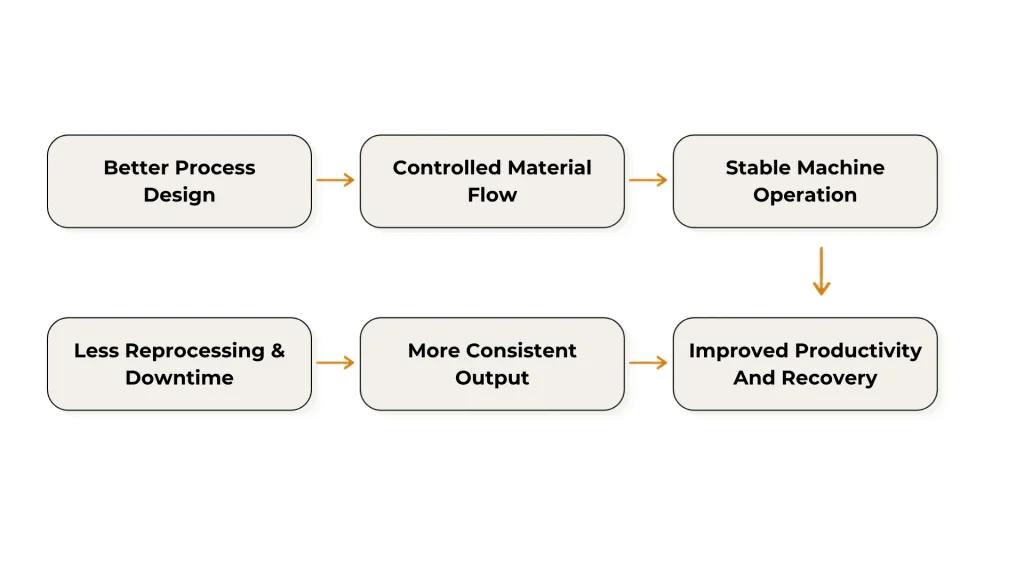
How Better Process Design Improves Productivity
When process design is right, material flows smoothly, and machines operate efficiently. This reduces grain damage, reprocessing, downtime, and operating costs. When every stage works properly, output becomes more consistent, and productivity improves. Even one process issue can affect the next stage, ultimately reducing overall output and recovery.
How Do Modern Rice Mills Improve Output & Productivity?
Modern rice milling focuses on improving the performance of the complete processing line rather than depending on individual machines.
1. Efficient Paddy Cleaning
When raw paddy enters a rice mill, it contains dust, stones, straw, mud particles, metal particles, and other foreign materials. If machines do not remove these impurities correctly, they can cause equipment damage, blockages, contamination, and production interruptions.
A well-designed cleaning section may include equipment such as:
- Pre-cleaner
- Destoner
- Drum-sieve
- Rotary separator
- Vibro separator
- Magnetic separator
- Husk aspirator
Effective cleaning provides a more consistent feed for downstream equipment and helps protect the machinery from unnecessary wear.
For a rice mill operating at commercial scale, this early stage should not be treated as a minor part of the process. Poor cleaning can create problems that appear later in dehusking, separation, and milling.
2. Controlled Dehusking
Dehusking is one of the most critical stages in rice milling. The objective is to remove the husk efficiently while minimizing unnecessary mechanical stress on the rice kernel.
Modern rice milling machinery can provide better control through well-designed rubber-roll dehusking systems and help maintain a more consistent process.
After dehusking, the material generally contains:
- Rice husk
- Brown rice
- Unhusked paddy
These fractions need to be separated and directed to the correct processing route. Poor dehusking or improper handling can increase grain damage and unnecessary reprocessing.
3. Accurate Paddy Separation
After dehusking, brown rice needs to be separated from the remaining unhusked paddy.
An efficient separation system ensures that:
- Brown rice moves forward to the milling section.
- Unhusked paddy is returned for appropriate reprocessing.
Poor separation can cause unnecessary circulation of rice and increase mechanical stress and material handling.
Accurate separation therefore helps maintain a smoother process flow and improve overall recovery.
4. Controlled Whitening and Polishing
Brown rice contains bran layers that must be removed when white rice is being produced.
Modern rice milling plants can use multiple controlled whitening stages instead of relying on one aggressive operation. This allows the process to be adjusted according to:
- Rice variety
- Grain characteristics
- Moisture condition
- Required degree of milling
- Product specifications
The aim is not simply to remove more bran. It is to achieve the required level of whitening while minimizing unnecessary grain stress and breakage.
Polishing can then improve the surface appearance and finish of the rice according to the requirements of the final product.
5. Grading and Sorting
Once rice has been milled and polished, grading is used to separate rice according to size and other product requirements.
Grading helps separate:
- Whole rice
- Broken rice
- Different grain sizes
Optical sorting can further remove unwanted grains such as:
- Discolored grains
- Damaged grains
- Chalky grains
- Foreign material
- Other unwanted visual defects
For rice manufacturers and exporters, this level of control can be important because buyers may have specific requirements for grain appearance, broken percentage, cleanliness, and consistency.
Better grading and sorting help maintain consistent product quality and ensure that different rice fractions are directed toward suitable applications.
How Does a Modern Rice Mill Reduce Waste?
Reducing waste is not limited to reducing broken rice. Losses can occur throughout the plant through poor handling, inefficient separation, excessive reprocessing, spillage, and equipment downtime.
- Reduced Grain Breakage
Controlled dehusking, whitening, polishing, and material movement can help reduce unnecessary mechanical stress on rice grains.
This is important because a higher proportion of whole rice can improve the commercial value recovered from the paddy.
- Less Reprocessing
Efficient separation and controlled process flow help prevent unnecessary circulation of material through the plant.
Less reprocessing means lower machine loading, reduced energy use, and less mechanical stress on the grain.
- Better Material Handling
Every unnecessary transfer of paddy or rice creates opportunities for:
- Spillage
- Product damage
- Dust generation
- Contamination
- Equipment wear
- Production delays
A properly planned material-handling system helps move products efficiently between processing stages while reducing avoidable losses.
Better Use of By-Products
Rice milling naturally produces several useful fractions, including:
| Milling Fraction | Potential Application |
| Rice husk | Fuel and industrial applications |
| Rice bran | Rice bran oil and other food-related applications |
| Broken rice | Food processing, rice flour and other applications |
| Brown rice | Consumer and specialty rice products |
| Whole rice | Main commercial product |
The actual value of each fraction depends on quality, market demand, available processing facilities, and local conditions.
For example, broken rice can be directed toward rice flour production or other food-processing applications rather than being treated simply as a loss.
Similarly, rice husk and rice bran can be collected separately and handled according to their intended applications.
Better segregation therefore turns by-product management into part of the overall resource-efficiency strategy.
How Do Automation and Monitoring Improve Rice Mill Productivity?
Automation can improve consistency across different stages of a rice milling plant, particularly where production volumes and process complexity justify it.
Depending on plant requirements, automation can be used for:
- Material conveying
- Machine sequencing
- Feed control
- Level monitoring
- Process monitoring
- Weighing
- Packing
- Centralized plant control
The main benefit is not simply reducing manual labour. Better automation can make process conditions more consistent and provide operators with greater visibility of plant performance.
Monitoring parameters such as material flow, machine load, moisture, yield, and product quality can also help identify problems earlier and support faster adjustments.
However, automation cannot compensate for poor plant design. It should be integrated into a properly engineered process.
Difference Between Modern Rice Mill And Conventional Rice Mill
The key difference between modern and conventional rice milling is the level of process integration and control.
| Area | Conventional Approach | Modern Approach |
| Process flow | More independent operations | Integrated process flow |
| Material handling | Greater manual intervention | More mechanized |
| Dehusking | More operator-dependent | More controlled |
| Whitening | Fewer processing stages | Multiple controlled stages where required |
| Separation | Greater process variation | Better controlled separation |
| Grading | Basic mechanical methods | Automated options available |
| Sorting | Manual or limited | Optical sorting options |
| Monitoring | More operator-dependent | Centralized monitoring options |
| By-products | Less systematic handling | Better collection and segregation |
| Maintenance | Often reactive | Greater scope for preventive maintenance |
The actual performance of a rice mill will still depend on paddy characteristics, machine selection, plant design, operating conditions, maintenance, and operator skill.
How Does a Modern Rice Mill Improve ROI?
Modernization can improve the economics of a rice milling business through several connected factors:
- Higher Value Recovery: Reducing unnecessary grain breakage can increase the proportion of whole rice recovered from the paddy.
- Lower Operating Costs: Better process flow and material handling can help reduce avoidable spillage, downtime, equipment wear, and unnecessary reprocessing.
- Better By-Product Utilization: Proper segregation of husk, bran, broken rice, and other fractions allows the mill to make better use of available materials.
- Consistent Product Quality: Better process control helps maintain consistent product specifications across production batches.
- Greater Production Flexibility: A properly designed rice processing plant can be configured to produce different rice grades and products according to market requirements.
How Should a Rice Mill Owner Modernize an Existing Plant?
Modernization should begin with identifying the actual problem, rather than immediately purchasing new machinery.
A practical approach is to:
- Assess current plant performance.
- Identify production bottlenecks and downtime.
- Locate grain-loss and breakage points.
- Review existing machinery and its condition.
- Examine material-handling systems.
- Define current and future production requirements.
- Set product-quality and recovery targets.
- Improve the process flow where required.
- Select machinery based on the identified requirements.
- Plan installation, commissioning, maintenance, and future upgrades.
This approach helps ensure that modernization addresses real production challenges rather than focusing solely on machine capacity or purchase price.
What Should You Consider When Selecting Rice Mill Manufacturers?
When planning a new rice mill plant or upgrading an existing facility, the machinery supplier should be evaluated as an engineering partner, not only as an equipment supplier.
Important factors include:
- Experience with similar rice milling projects
- Understanding of complete process flow
- Plant layout and engineering capabilities
- Equipment integration
- Machine reliability
- Ease of maintenance
- Spare-parts availability
- Installation and commissioning support
- Operator training
- Technical support
- Future expansion capabilities
Flourtech Engineers provides integrated rice milling solutions covering plant design, rice mill machinery, process integration, automation, installation, and technical support. The right solution is selected according to factors such as paddy variety, plant capacity, product requirements, available space, and future expansion plans.
Conclusion
A modern rice milling plant improves productivity by focusing on the complete processing system, not just individual machine capacity.
Efficient cleaning, controlled dehusking, accurate separation, controlled whitening, effective grading, efficient material handling, automation, and better monitoring can work together to reduce avoidable losses and improve process consistency.
For rice mill owners, modernization should therefore be approached as a process improvement strategy. The right plant design and machinery configuration can help achieve better recovery, consistent quality, reduced waste, lower downtime, and more sustainable productivity.
For a new rice mill plant, capacity expansion, or modernization project, the starting point should always be an evaluation of the entire process and the business’s specific requirements.
Build a More Efficient Rice Milling Plant
Flourtech Engineers provides integrated rice milling solutions designed to improve productivity, recovery, quality, and process efficiency.
Talk to our experts to plan the right rice milling solution for your plant.
Website: www.flourtech.com
Contact: +91-9663594709