
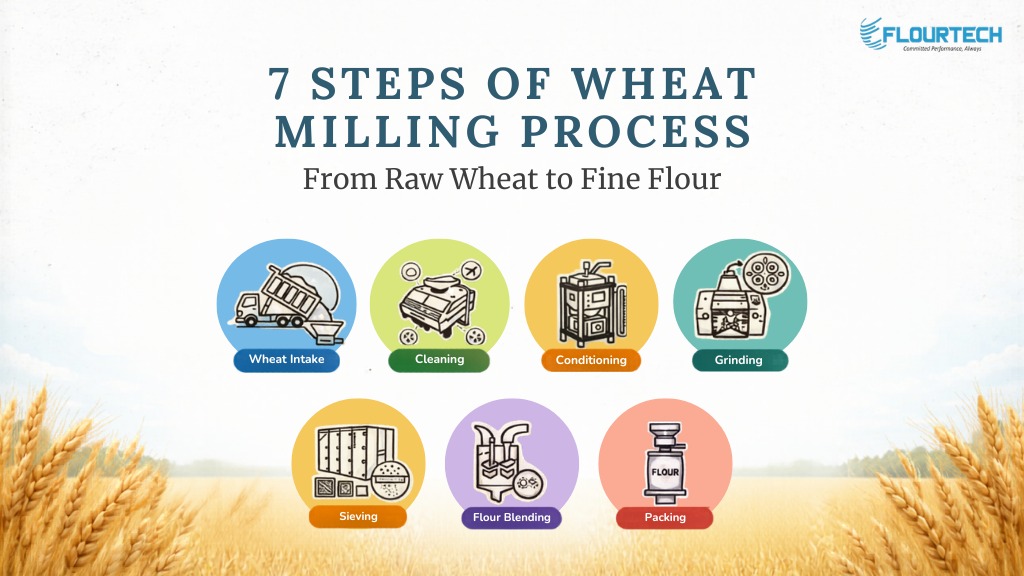
The journey from raw wheat to fine flour is far more difficult than most people consider. Behind every modern flour mill plant lies a carefully engineered system built for efficiency, consistency, and food safety. Insight into the wheat milling process is crucial— not just for millers, but for food manufacturers, grain processors, and businesses across the supply chain.
Here, we share a clear breakdown of the 7 most important steps involved in the wheat milling process.
1. Cleaning
The process begins with a thorough cleaning of raw wheat to remove all foreign matter before it enters the mill.
Wheat arriving at the mill typically contains a range of impurities. These are removed using specialized equipment, including:
- Destoners to eliminate stones and heavy foreign matter
- Magnetic separators to extract metal particles
- Grain separators to remove broken or shriveled kernels
- Air aspiration systems to remove dust and light particles
Proper cleaning is critical for food safety, final flour quality, and protecting expensive milling machinery from damage.
2. Tempering and Conditioning
After cleaning, the milling process tempers the wheat — a process where operators add a controlled amount of water and allow the grain to rest for a set period.
During this stage, the following changes take place:
- The outer bran layer toughens, making it easier to separate
- The inner endosperm softens for more efficient grinding
- Moisture is evenly distributed throughout the grain
- The grain becomes more suitable for controlled milling
Tempering directly influences the flour extraction rate and overall milling efficiency. The duration and moisture level are adjusted based on the wheat variety.
3. Grinding — The Break System
The tempered wheat is now fed into roller mills fitted with corrugated rollers. These rollers break open the wheat kernel, separating it into three main components:
- Bran — the tough outer layer
- Germ — the nutrient-rich embryo
- Endosperm — the starchy core that produces flour
This stage involves multiple break passes, with the gap between rollers gradually reducing to achieve controlled size reduction. The break system is the foundation of the entire wheat flour production process.
4. Separation and Sifting
After each grinding pass, the broken material is sent into plansifters — machines equipped with multiple mesh sieves. The sifting process achieves the following:
- Fine flour particles are collected and directed to flour streams
- Semolina and middlings are suitable for further processing
- Coarse bran is separated and removed
- Particles are accurately graded by size for consistent quality
This step ensures uniform particle size and consistent flour quality across every batch.
5. Purification
Purification refines the semolina and middlings obtained from sifting. A purifier uses a combination of vibrating sieves and upward air currents to achieve the following:
- The airflow lifts lighter bran particles and removes them from the grain stream.
- Denser, cleaner semolina passes through the sieves
- The semolina is graded into different quality streams
- The purification process minimizes bran contamination before final grinding.
The result is a purer intermediate product ready for final grinding. This step plays an important role in the production of premium flour grades used in bakery and food processing applications.
6. Reduction — Final Grinding into Flour
In the reduction system, the purified semolina passes through smooth reduction rollers. Key characteristics of this stage include:
- Smooth rollers apply gentle, progressive pressure
- Multiple reduction passages refine the flour gradually
- Mills that reduce their particle size to meet the required specifications.
- Heat generation is minimized to preserve flour quality
This stage directly determines the performance of the flour in baking and food manufacturing.
7. Blending and Packaging
In the final stage, the milling system blends flour streams from different milling passages and prepares them for the market. This stage involves:
- Blending multiple flour streams for a consistent, standardized product
- Fortification with vitamins and minerals as per regulatory requirements
- Hygienic packaging for retail or bulk B2B distribution
- Quality checks to ensure compliance with food safety standards
This stage ensures shelf stability, product consistency, and full compliance with food safety regulations.
Why the Wheat Milling Process Matters
A well-managed milling process delivers significant benefits at every stage of the production chain.
- Higher flour yield via optimized extraction rates
- Consistent product quality that meets customer and regulatory standards
- Reduced wastage at every stage of production
- Stronger food safety compliance from grain to finished product
- Better machinery performance through proper process management
Each of these seven steps plays a specific and important role. Skipping or poorly executing any one of them affects the quality of the final product, the plant’s efficiency, and ultimately the business’s profitability.
Modern grain processing technology continues to advance, but the fundamental logic of these 7 steps remains the backbone of every successful flour milling operation.
Want to know more about the technical and mill-specific aspects of wheat processing machines? Connect with our experts through www.flourtech.com or call us at +91-9663594709.
Frequently Asked Questions (FAQs)
The wheat milling process is a step-by-step method of converting raw wheat into flour through cleaning, grinding, separating, and refining.
The wheat milling process includes cleaning, tempering, grinding, sifting, purification, reduction, and final blending & packaging.
Modern technology improves efficiency, reduces waste, ensures food safety, and consistently delivers high-quality flour.
Millers, food manufacturers, grain processors, and even consumers benefit from understanding how flour mills produce flour.
Cleaning removes impurities like dust, stones, and metal particles, ensuring food safety, better flour quality, and smooth machine operation.
Grinding uses roller mills to break wheat into bran, germ, and endosperm, with the endosperm further processed into flour.
These steps separate fine flour from coarse particles and remove remaining bran, ensuring uniform texture and high-quality flour.
Each step—from cleaning to grinding—ensures the flour is safe, consistent, finely textured, and suitable for baking or cooking.