Whenever we think about flour quality, the first thing that comes to mind is the quality of wheat used to produce flour. But to assess flour quality, the final result depends on the methods used to process the wheat in a flour mill. Actually, the most important stage is milling itself, which will determine the characteristics of flour such as appearance, size of flour particles, colour, etc.
In a modern flour mill, wheat doesn’t become flour in a single step after cleaning. The grinding section uses several roller mills and plansifters in a single row. After each stage, the plansifter separates the finished flour, which is carried by conveyor to the packaging section. The remaining coarse material moves on to the next machines for further grinding. This process repeats again and again until all the wheat has been turned into flour.
With this arrangement of machines, wheat undergoes repeated grinding and sieving at different stages of the milling process. This helps separate fine flour particles from bran and other coarse materials. The quality of flour depends on the performance of each machine, on the arrangement of machines in the mill, and on how smoothly the material moves between sections.
Let’s understand how the grinding process works in a flour mill and why each stage matters.
1. How the Grinding Process Starts in a Flour Mill
Before the wheat reaches the grinding section, it is first cleaned and conditioned. This gets the grain ready for milling and makes it easier to separate the flour from the bran. The wheat is then carried to the grinding section by conveyors and elevators.
Here, it first passes through a volumetric doser. This machine controls the amount of wheat that can be fed at every point in time, making sure the feed is consistent. Then magnets extract any metallic items mixed in with the wheat. This is necessary because if the metallic parts enter into the grinding machine, they may damage the rolls.
At that point, the grain goes to the first roller mill, which means that the grinding process finally begins. The roller mill doesn’t grind the entire kernel at once. It opens and grinds the grain step by step, it helps to separate the inner part easily (the endosperm).
The ground material then moves to the plansifter. It sifts the material by size. The part that has already become flour falls to the bottom and goes by conveyor to the packaging section. The coarser material that stays on top goes to the next roller mill for further grinding.
2. Roller Mill: The Main Machine Behind Grinding
Roller mills are the main machines that grind wheat into smaller particles in a flour mill.
Each roller mill has two rolls that turn against each other and press the material between them. Two types of rolls are used, and each has a different job.
- Grooved Rolls in the Break System
The first 2-3 roller mills use grooved rolls. Their job is to open the wheat kernel and separate the endosperm (the inner part that becomes flour) from the bran (the outer skin). However, they do it without making the bran pieces very small.
This helps in separating the parts of wheat for the next stage of sifting.
- Smooth Rolls in the Reduction System
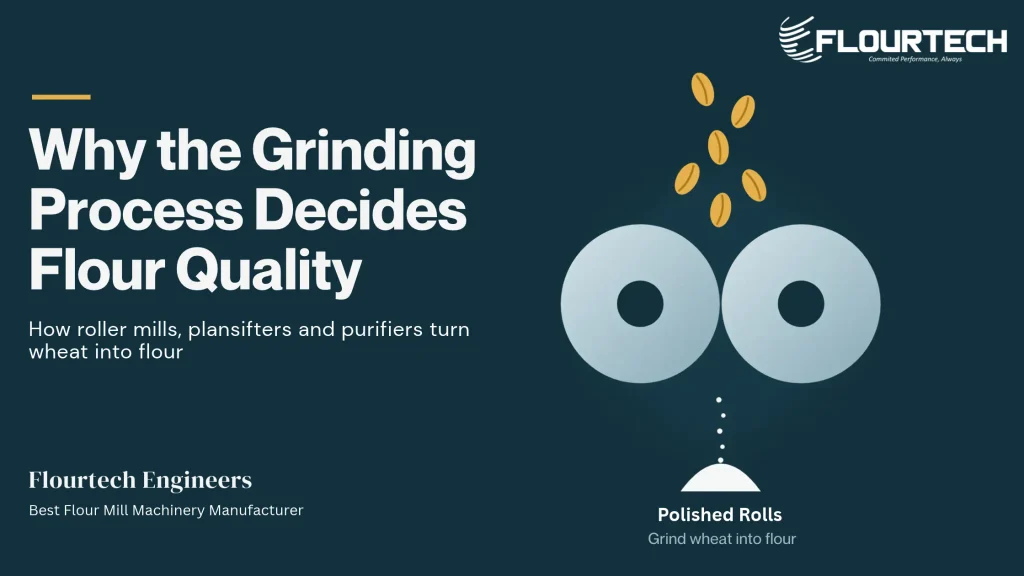
After this first separation, the endosperm particles move on to the reduction system. Here, smooth (polished) rolls are used. They gradually grind the endosperm into finer particles until it becomes flour.
Why a Flour Mill Uses Many Roller Mills
A flour mill does not grind wheat with just one machine. It uses many roller mills, one after another, and the gap between the rolls is different in each one.
In the first roller mill, the gap between the rolls is wider. In the next mill, the gap is smaller, and in the one after that, it is smaller still. The wheat is ground a little more at every stage, instead of being crushed all at once.
The roll gap is set according to the product the client wants, such as atta, maida, or sooji. This is why each roller mill has its own role, and its settings depend on the material it receives and the final product.
3. Plansifter: Where Ground Material Gets Separated
After the roller mill, the ground material goes to the plansifter.
A plansifter consists of several layers of sieves (screens) whose purpose is to separate the material based on its size. It doesn’t grind anything. Its main purpose is to determine which particles are ready to go to the next step and which ones need extra grinding.
The material is usually divided into two lines:
- Fine Material: Particles that pass through the sieves are collected and sent to the flour or respective product section, it depends on their quality and the product needed.
- Coarse Material: Larger particles that stay on top of the sieves are sent to the next roller mill for more grinding.
Once all particles of the appropriate size have been collected, the remaining material returns to the grinding process.
Why Every Plansifter Has Different Sieves
Flour production requires numerous plansifters in which the sizes of the sieves differ depending on the material that is processed at each stage. Every plansifter is arranged with the sieves that are appropriate for the material that it works on. The size of the screens is also adjusted according to the type of flour that is needed, for example, atta, maida, or sooji.
The plansifter and roller mill work closely together. Even if the roller mills are working well, wrong sieve sizes can disturb the material flow and affect the final results.
4. Purifier: Improving the Separation of Semolina and Middlings
After passing through the grinding and sifting process, some of the wheat remains with both the inner portion (endosperm) and the outer portion (bran) together. It is required to undergo one more cleaning process before it is sent into the next roller mill machine. This step is carried out using a vibro purifier.
A purifier uses a combination of a vibrating sieve along with a stream of air. In this process, heavier particles (such as sooji) are left on the sieve, while the lighter bran particles are blown away by the airflow, thus cleaning the material once again.
The purifier is placed after the plansifter. The sooji separated by it is then sent for packaging. Meanwhile, the remaining material is sent to the next roller mill where further grinding takes place.
Purifiers are utilized at different stages. Their placement varies according to the milling diagram and the products that the mill produces at the moment. This stage is especially important when more than one product is produced in the mill, such as maida, sooji, and flour.
5. Impact Detacher: Breaking Lumps Before Sifting
As the polished (smooth) rolls grind the material into a very fine flour, it becomes pressed together. It becomes formed as small flakes and lumps. The impact detacher is used after certain smooth roller mills to break these flakes and lumps. The rotating part of the device hits the lumps and breaks them apart inside the machine.
Then the material goes back to the plansifter. Now, the plansifter can separate the material according to size now that all the lumps are separated.
Impact detachers are used only after smooth rolls, not after grooved rolls. This is because grooved rolls work differently and do not produce flakes and lumps of this kind. Placing the impact detacher at the right stage keeps the material flowing smoothly between grinding and sifting.
6. Bran Finisher: Recovering More Usable Flour
Separating the bran is an important part of flour milling.
In the earlier grinding and sifting stages, some flour (endosperm) can be stuck with the bran. If this is not separated, this flour sticks onto the bran and is lost. The bran finisher is used to recover this flour. It is positioned after the plansifter, before the last few roller mills. It separates the remaining bran from the flour.
After recovery, the flour is sent for further processing to the roller mill. The bran that is left is collected separately as well. In larger mills, the number of bran finishers depends on the production capacity of the milling process.
A good bran finisher machine means less flour is wasted and more flour is recovered from the same wheat.
7. Impact Mill: An Important Part of Finished Flour Handling
Once the flour or maida is collected, it is moved to the finished-product section.
An impact mill is often used in many flour mills in the process just before the flour gets packaged. An impact mill is placed at the end of the process, that is, after it passes through the last roller mill.
The impact mill machine hits flour with a strong mechanical impact. This destroys all insects and insect eggs that are present in the flour. It works as an extra safety step for insect control and is part of keeping the finished product safe and clean.
Whether to use an impact mill, where and when it is used, and various factors such as the plant layout, production capacity, and compliance with food safety guidelines. After this step, the flour goes to the packaging section.
8. Role of Elevators, HP Fans and Jet Filters in Flour Milling
Besides the grinding and separating machines, a flour mill also needs supporting machines to keep the material moving through the plant.
These machines do not grind the wheat, but the plant cannot run smoothly without them.
- Bucket Elevators
Bucket elevators lift wheat and other materials from one floor to another. They carry the material between machines and sections, wherever it needs to go up.
- HP Fans
HP fans supply the air that moves the material through pipes. This is called pneumatic conveying. The air carries the material from one machine to the next, so it keeps flowing continuously and smoothly.
- Pneumatic Cyclones
Pneumatic cyclones separate the material from the air after it has been carried through the pipes. They are placed at the points where the material is collected.
- Jet Filters
While the material is carried by air, dust can stay mixed in the air. Jet filters separate this dust from the air and keep the air clean.
- Conveyors
Screw conveyors and other conveyors move the material sideways, from one section of the plant to another. For example, they carry the finished flour to the packaging section.
Together, these machines keep the material moving without a break and reduce manual handling.
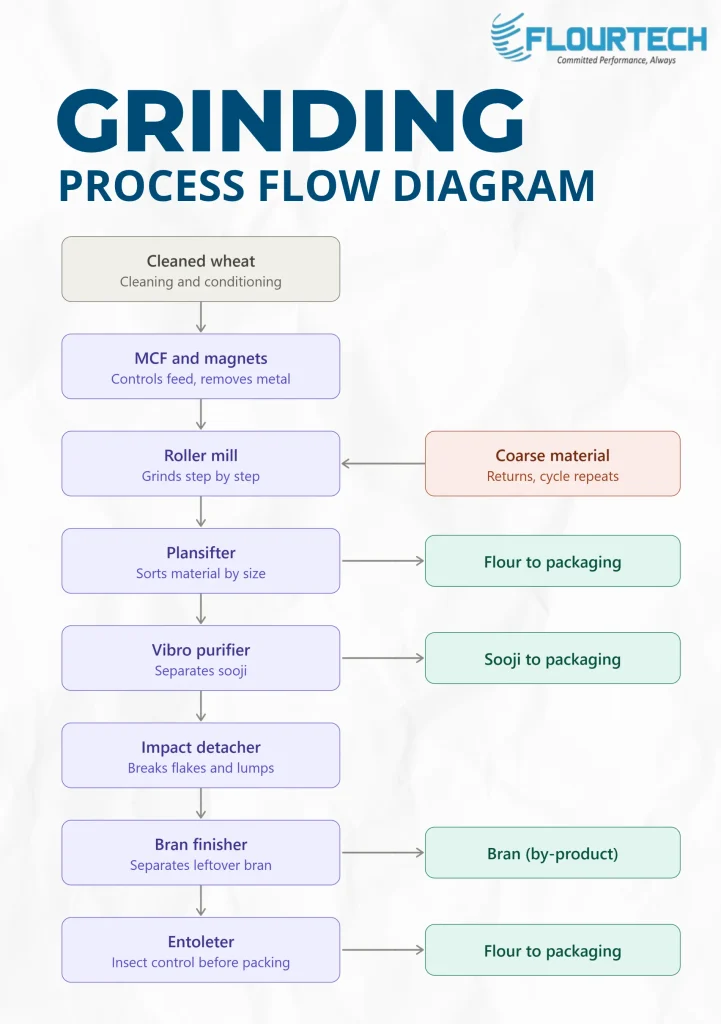
How the Grinding Process Works in a Modern Flour Mill
The grinding process is not a straight-line operation. It is a continuous cycle in which material moves between roller mills, plansifters, and other separation machines. In the 160+10 TPD milling flow, it works like this:
- Feeding: Cleaned and conditioned wheat reaches the grinding section through conveyors and elevators. The volumetric doser (MCF) controls how much wheat moves forward, and magnets pull out metal pieces that could damage the rolls.
- Grinding: The roller mill opens the wheat and grinds it step by step.
- Sifting: The plansifter sorts the ground material by size. Finished flour falls through and goes by conveyor to the packaging section. The coarse material goes to the next roller mill.
- Purifying: Before the smooth roll stages, vibro purifiers separate sooji and other products. Sooji goes to packaging, and the rest moves on to the next roller mills.
- Breaking lumps: After the smooth rolls, impact detachers are used to break the flakes and lumps that are formed during the grinding process. Magnets placed between machines keep catching any metal particles.
- Recovering flour from bran: Before the last few roller mills, bran finishers separate the remaining bran from the flour. The flour goes back for further grinding.
- Repeating the cycle: This process once again repeats stage after stage until all the wheat has turned into flour.
- Final protection: Before packaging, the impact mill destroys any insects or eggs in the flour. Then the flour is sent to the packaging section.
Throughout this process, HP fans provide the air that keeps material moving smoothly from one machine to the next. The total number of machines used in the process depends on the milling design, the production capacity, and the products that need to be made.
How Different Products Are Collected from the Flour Mill
A well-built flour mill can process wheat in a way that produces different items from the grain. This depends on the grinding passages and the separation system in use.
In the case of a shared milling structure, there are different outlets for bran, sooji, and other types of maida.
- Maida: During milling, the endosperm is gradually separated from the wheat kernel and ground into fine particles. These particles are collected as maida according to the required quality.
- Refined Wheat Flour: Fine flour is collected through different grinding and sieving stages. It is processed to achieve the required smooth texture, colour, and fineness.
- Normal Wheat Flour (Atta): Wheat is ground and passed through sieves to get flour with the required texture. The collected flour is used for normal wheat flour (atta) production.
- Sooji: Some larger particles of the endosperm are separated with the help of the plansifter and purifier. These particles are collected as sooji when the mill is designed to produce it.
- Bran: Bran is the outer covering of the wheat kernel. The bran finisher helps separate the remaining flour particles from the bran before it is collected separately.
- Flour for Different Uses: Different flour fractions can be collected separately according to their texture and quality. This helps produce flour suitable for different customer and market requirements.
The final product arrangement depends on the customer’s requirements, desired product specifications, and the design of the milling system.
This is why the machinery arrangement of one flour mill may differ from another, even when both plants process wheat.
What Should Be Considered When Designing a Flour Mill Grinding System?
A flour mill cannot be designed by selecting individual machines without considering how they will work together. Every machine needs to be placed according to its function and the movement of material through the plant.
Some important factors to consider include:
- Product Requirements: Whether the customer wants atta, maida, sooji, or multiple finished products.
- Production Capacity: The required output determines the number and capacity of roller mills, plansifters, and other machines.
- Grinding Passages: The milling diagram should provide suitable grinding and separation stages.
- Sifting Arrangement: Plansifters should have the right sieve configuration for the material being processed.
- Purification Requirements: The number and placement of purifiers depend on the required separation and product quality.
- Material Handling: Elevators, conveyors, and pneumatic systems should support continuous product movement.
- Automation: Suitable automation and monitoring systems help operators manage the process and identify variations.
- Maintenance: Regular inspection of rolls, sieves, filters, and conveying equipment helps maintain reliable performance.
A well-planned grinding system helps avoid unnecessary material circulation, improves separation, and maintains consistent production.
Conclusion
The grinding process is one of the most important parts of flour milling because it determines how effectively wheat is converted into different finished products.
However, good flour quality does not depend on the roller mill alone. Plansifters, purifiers, impact detachers, and bran finishers all contribute to the way material is processed and separated. Supporting equipment such as elevators, conveyors, HP fans, and jet filters keeps the entire system moving. When all these machines are selected and arranged according to the required milling process, a flour mill can achieve better control over product quality, flour recovery, and overall plant performance.
At Flourtech Engineers, we understand that every flour milling project has its own processing requirements. From process planning and machinery selection to manufacturing, installation, and commissioning, we focus on developing integrated flour milling solutions that meet the needs of each customer. The right milling arrangement is not just about installing machinery. It is about making every stage of the process work as it should.
Need a Flour Milling System That Matches Your Production Requirements?
Get the right combination of roller mills, plansifters, and separation machinery with a well-planned grinding system. Flourtech Engineers offers complete flour milling solutions, from process planning and machinery selection to installation and commissioning.
Contact Flourtech Engineers to discuss your flour milling requirements and find the right solution for your business.
Visit our website: www.flourtech.com
Phone Number: +91-9663594709