In a flour mill, grinding wheat is only one part of the milling process. After grinding, the system separates the material by particle size and directs fine flour, semolina, and other intermediate materials to their respective processing stages. This is where a plansifter plays an important role.
A plansifter is an essential machine in modern flour milling plants. It uses multiple sieve layers to classify ground material and helps maintain a smooth flow between different stages of milling. From separating fine flour to directing coarse particles for further grinding, it supports the overall efficiency of the milling process.
Understanding how a plansifter works, its different types, components, and applications can help mill owners make better decisions when selecting flour milling equipment.
What Is a Plansifter?
A plansifter is an industrial sieving machine used in flour mills to separate ground grain material into different fractions according to particle size. It generally consists of multiple sieve frames arranged in layers inside a machine body.
During operation, the machine produces a controlled gyratory movement that allows the material to travel across the sieve surfaces. Smaller particles pass through the mesh openings, while larger particles remain on the sieve and move towards separate outlets.
Plansifters mainly operate after roller mills, where the grinding process produces a mixture of fine flour, intermediate particles, and bran-containing material.
By separating these fractions, the machine helps direct each material towards the next stage of processing.
Why Is a Plansifter Important in a Flour Mill?
During wheat grinding, all particles do not reach the same size. Some become fine enough to be collected as flour, while others require additional grinding or further separation.
Without proper sieving, these different materials would remain mixed, making it difficult to control the milling process.
A plansifter helps solve this problem by:
- Separating materials according to particle size.
- Collecting fine flour from the ground stock.
- Identifying intermediate particles for further processing.
- Directing coarse material towards the appropriate roller mill passage.
- Supporting better control over material movement throughout the plant.
This makes the plansifter an important part of the milling system, as it helps maintain an organised and continuous processing flow.
How Does a Plansifter Work?
A plansifter works by combining controlled machine movement with multiple sieve surfaces. Its operation involves a series of steps.
Step 1: Material Feeding
Ground material from the roller mill enters the plansifter through its feeding inlet. The feeding arrangement distributes the material across the assigned sieve compartments.
Step 2: Material Distribution
The machine’s gyratory movement helps spread the material over the sieve surfaces. This allows the particles to move across the mesh instead of collecting in one place.
Step 3: Particle Separation
As the material moves across the sieves, smaller particles pass through the mesh openings. Larger particles remain on the sieve surface and continue towards their designated outlets.
Step 4: Collection of Different Fractions
The separated materials are collected through different internal channels. Each fraction follows a specific route depending on its particle size and the milling diagram.
Step 5: Transfer to the Next Processing Stage
Fine flour may move towards collection or further handling, while intermediate and coarse materials can be directed to purifiers or roller mills for additional processing.
In this way, a plansifter helps maintain the flow of materials between different milling operations.
What Is the Working Principle of a Plansifter?
The working principle of a plansifter is based on particle-size separation through sieving and controlled gyratory motion.
The machine moves in a circular or gyratory pattern, allowing the material to travel across multiple sieve surfaces. As particles come into contact with the mesh, those smaller than the openings pass through, while larger particles remain on the sieve.
Different sieve layers use selected mesh openings to separate the material into specific fractions.
The effectiveness of this process depends on factors such as mesh size, material characteristics, feed distribution, and machine movement.
What Are the Different Types of Plansifters Used in Flour Mills?
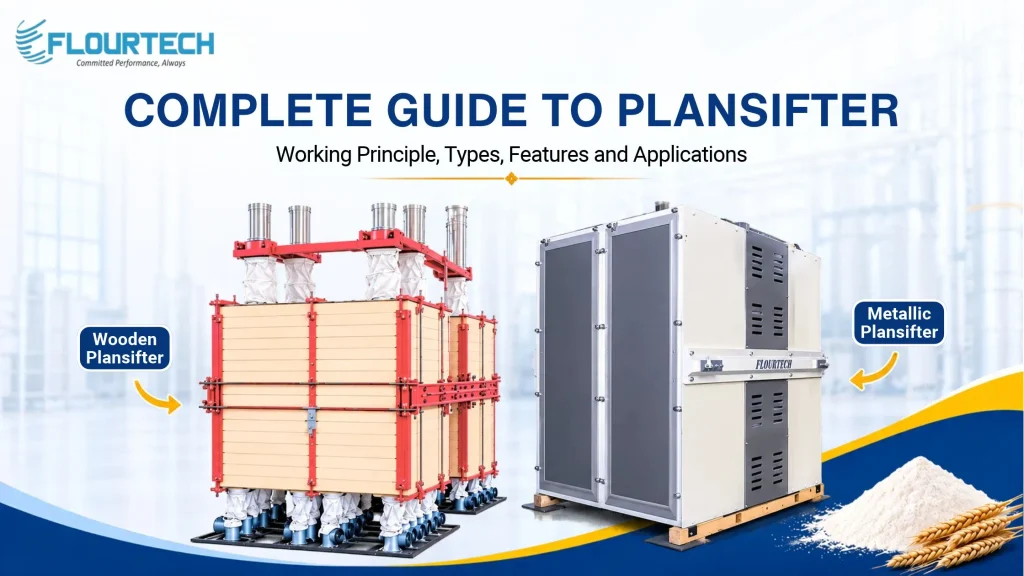
Plansifters can be classified by their construction and design. Here are the two main types of plansifters:
A. Wooden Plansifter
A wooden plansifter uses wooden structural components, such as seasoned hardwood or plywood, in its construction. This design has been used in traditional flour milling systems. Its internal sieve arrangement and maintenance requirements depend on the specific machine design.
B. Metallic Plansifter
A metallic plansifter uses metal components, such as steel, aluminium, or stainless steel, in its structure. Metallic designs are commonly used in modern industrial milling plants. The frame design and finish can vary by manufacturer and machine specifications.
Wooden vs Metallic Plansifter: The main difference between wooden and metallic plansifters lies in their construction material, design, and maintenance requirements. However, you should not judge machine performance by construction material alone. Sieve arrangement, structural design, balancing, capacity, and ease of maintenance should also be considered.
| Point | Wooden Plansifter | Metallic Plansifter |
|---|---|---|
| Build | Wooden frames and body | Steel or aluminium frames and body |
| Weight | Generally lighter | Usually heavier |
| Sieve Surface Area | Comparatively less sieve surface area | Generally more sieve surface area |
| Hygiene | Needs careful moisture and pest control | Smooth surfaces support easier cleaning |
| Durability | Can be affected by humidity over time | Generally offers better resistance to environmental conditions |
| Ease of Cleaning | Requires complete opening of the machine for thorough cleaning. | Metal sheets can be opened, and sieves can be easily removed, cleaned, and reinstalled. |
| Initial Cost | Generally lower | Generally higher |
What Are the Main Components of a Plansifter and Their Functions?
A plansifter consists of several components that work together to achieve proper material separation.
- Sieve Frames: These hold the sieve mesh in position and form different sieving layers.
- Sieve Mesh: The mesh openings determine which particles pass through and which remain on the sieve.
- Feeding Inlet: It allows the ground material to enter the machine for separation.
- Main Chassis: It provides the main supporting structure for assembling and holding all the sieve units in position.
- Distribution System: It spreads the incoming material evenly across the sieve surfaces.
- Sieve Cleaning Mechanism: Cleaning elements help prevent material from blocking the mesh openings and maintain smooth sieving.
- Discharge Outlets: These collect and direct separated materials towards their respective processing stages.
- Drive Mechanism: It generates the movement required for the sieving process.
- Balancing System: Counterweights and other balancing arrangements help maintain stable machine movement.
- Suspension System: It supports the machine body while allowing the required movement during operation.
The arrangement and design of these components may vary depending on the type and model of the plansifter.
What Are the Important Features of an Industrial Plansifter?
When evaluating a plansifter for industrial use, certain features are important for its operation and maintenance.
Some key features include:
- Multiple sieve compartments for separating different material fractions.
- Proper material distribution across the sieve surfaces.
- A suitable sieve cleaning arrangement.
- A balanced drive system for controlled movement.
- Proper sealing to minimise material leakage.
- Convenient access for inspection and cleaning.
- A suitable sieving area according to plant requirements.
- Construction designed for continuous industrial operation.
These features help determine how effectively a plansifter can work within a flour milling system.
Where Are Plansifters Used in Grain Milling?
Plansifters are mainly associated with flour milling, but their use is not limited to wheat processing. Depending on their design and sieve configuration, they can also be used in other grain and cereal processing plants. Common applications include:
- Wheat Flour Mills: Used to separate flour, semolina, middlings, and other intermediate fractions.
- Maize Milling Plants: Used for classifying different particle sizes during maize processing.
- Semolina Production: Helps classify intermediate particles according to the required size.
- Cereal Processing Facilities: Used in suitable applications where dry materials need to be separated through sieving.
The sieve arrangement and machine specifications should always match the material being processed.
What Products and Materials Can a Plansifter Separate?
A plansifter helps separate different fractions produced during grinding. The actual output depends on the milling diagram, sieve arrangement, and processing requirements.
Some common materials include:
- Fine Flour or Maida: Fine particles that pass through the selected sieve openings and are collected as flour fractions.
- Semolina or Sooji: Selected coarser endosperm particles that can be sent for further purification.
- Middlings: Intermediate particles that may require additional grinding or purification.
- Coarse Endosperm Particles: Larger particles that can be returned to the roller mill for further size reduction.
- Bran-Containing Fractions: Material with bran particles that can be sent to suitable separation equipment.
It is important to understand that a plansifter does not independently manufacture all these products. It classifies the material so that the remaining milling operations can produce the required final products.
How Does a Plansifter Fit Into the Flour Milling Process?
A plansifter works as part of a connected flour milling system rather than operating independently. After wheat passes through the roller mill, the ground material is transferred to the plansifter for classification.
The different fractions then follow their respective routes:
- Fine flour fractions are collected for further handling and finished-product processing.
- Selected intermediate particles may be sent to a purifier for further separation.
- Coarse material requiring additional grinding is directed towards the next roller mill passage.
- Bran-containing fractions can be transferred to a bran finisher or other suitable equipment.
This process continues through different grinding and sifting stages until the required flour and other products are obtained. The exact material flow depends on the plant capacity, milling diagram, and final product specifications.
How Does a Plansifter Help Maintain Consistent Flour Quality?
Flour quality depends on several factors, including wheat characteristics, conditioning, grinding, and separation. A plansifter supports this process by helping control the particle sizes moving between different milling stages.
Its contribution includes:
- Separating fine particles from larger material.
- Supporting more uniform particle-size classification.
- Directing intermediate fractions for suitable further processing.
- Helping control the amount of material returned for grinding.
- Supporting consistent material flow throughout the milling plant.
Although a plansifter does not determine flour quality on its own, its proper operation contributes to better process control and consistent milling results.
What Are the Major Advantages of Using a Plansifter?
A properly selected and maintained plansifter offers several advantages in flour milling operations.
- Efficient Material Separation: Helps classify ground material according to different particle sizes.
- Better Process Control: Directs different fractions towards the appropriate processing stages.
- Continuous Operation: Supports the movement of material through multiple milling passages.
- Improved Milling Efficiency: Helps avoid unnecessary mixing of fine and coarse fractions.
- Better Material Utilisation: Allows intermediate particles to be sent for further processing.
- Flexible Sieve Arrangement: Different mesh configurations can be selected according to milling requirements.
These advantages make plansifters an important part of commercial flour milling plants.
What Factors Affect Plansifter Performance?
Several operating and technical factors can influence the separation performance of a plansifter.
- Sieve Mesh Size: Incorrect mesh selection can affect the separation of different particle sizes.
- Feed Rate: Excessive or uneven feeding may prevent proper use of the available sieve surface.
- Material Moisture: High moisture content can cause particles to stick together or block sieve openings.
- Sieve Condition: Damaged, worn, or blocked mesh can affect separation accuracy.
- Machine Balancing: Improper balancing may cause unwanted vibration and affect smooth operation.
- Cleaning System: Ineffective sieve cleaning can reduce the available mesh area for separation.
- Regular Maintenance: Inspection of the drive system, suspension, sieve frames, and other components helps maintain reliable operation.
What Are the Common Plansifter Problems and Maintenance Requirements?
Like other flour milling machines, plansifters require regular inspection and maintenance. Some common problems include:
- Blocked Sieve Mesh: Material accumulation can reduce the effective sieving area. Regular cleaning and inspection help prevent this issue.
- Uneven Material Distribution: Incorrect feeding or distribution can affect separation performance.
- Excessive Vibration: Problems with balancing, suspension, or drive components may cause unwanted vibration.
- Material Leakage: Damaged seals or improper fitting can lead to leakage between compartments.
- Reduced Separation Efficiency: Worn or damaged sieve mesh can affect the quality of separation.
Routine maintenance should include checking sieve frames, cleaning elements, seals, drive components and balancing arrangements. Following the manufacturer’s maintenance instructions also helps support safe and reliable operation.
How Do You Choose the Right Plansifter for Your Flour Mill?
Selecting the right plansifter is important for achieving the required milling performance. Before purchasing a machine, consider the following points:
- Processing Capacity: Select a machine that matches the required plant capacity.
- Type of Grain: Consider whether the plant will process wheat, maize, or other cereals.
- Sieving Area: Check the available sieving area according to the required material separation.
- Sieve Configuration: The number of compartments and mesh arrangement should match the milling diagram.
- Plant Layout: Consider the available installation space and material transfer arrangement.
- Maintenance Requirements: Look for a design that allows convenient inspection and cleaning.
- Machine Compatibility: Ensure that the plansifter can work properly with the roller mills, purifiers, and other connected equipment.
- Manufacturer Support: Consider technical guidance, installation assistance, and after-sales service.
The right machine should be selected according to the complete milling requirement rather than capacity alone.
Why Is a Plansifter Important in a Turnkey Flour Mill Project?
In a turnkey flour mill project, every machine needs to work in coordination with the complete processing system. A plansifter plays an important role in maintaining the required material flow between grinding, separation, and further processing stages. Its selection and installation require proper planning of sieve arrangements, machine capacity, material routing, and integration with other equipment.
At Flourtech Engineers, turnkey flour milling solutions involve planning and integrating machinery according to the plant’s processing requirements. From machine design and manufacturing to installation and commissioning, proper coordination between different milling stages helps establish an organised and efficient flour milling system.
Conclusion
A plansifter is much more than a sieving machine in a flour mill. It plays an important role in separating ground material, managing intermediate fractions, and maintaining a continuous flow between different milling stages.
Understanding its working principle, components, types, and applications helps flour mill owners select suitable equipment according to their processing requirements. When properly selected, installed, and maintained, a plansifter supports efficient milling operations and consistent product quality.
At Flourtech Engineers, we offer plansifters as part of our flour milling machinery range. Our solutions are designed to support efficient sieving, proper material separation, and smooth operation throughout the milling process.
Planning to set up a new flour mill or upgrade your existing plant?
Get in touch with Flourtech Engineers to explore suitable flour milling machinery and plansifter solutions for your processing requirements.
Contact us: +91 8826731010, +91-9663594709
Website: www.flourtech.com