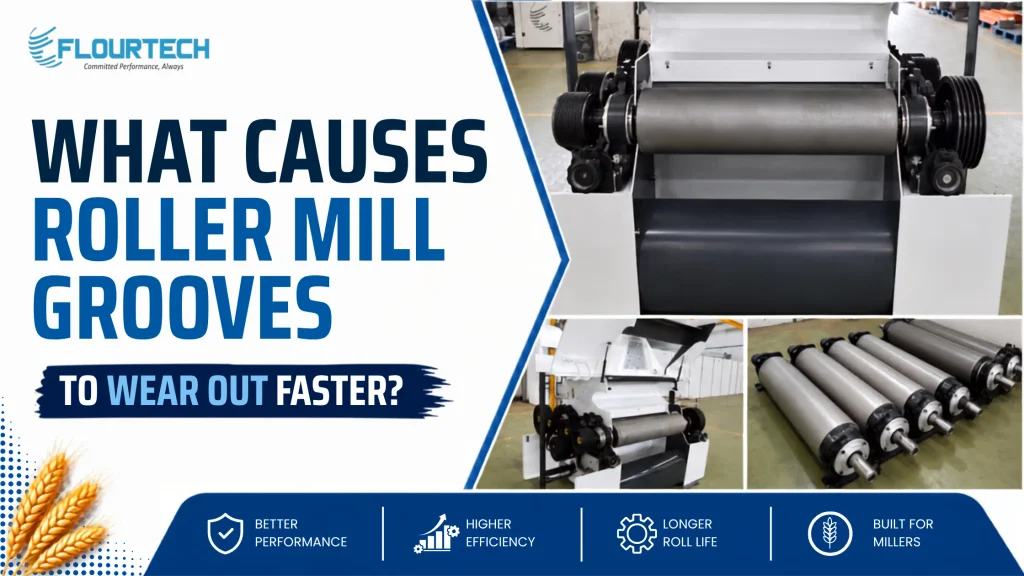
Roller mills are an important part of modern flour milling, where the condition of the rolls directly affects grinding performance, product consistency, and overall milling efficiency. Over time, the grooves on roller mills naturally wear due to continuous operation. However, when grooves wear faster than expected, it can indicate problems with operating conditions, wheat preparation, roll settings, or maintenance practices.
Understanding the common causes of groove wear can help flour mill operators identify problems early, maintain consistent milling performance, and avoid unnecessary roll replacement or maintenance costs.
What Are Roller Mill Grooves and Why Do They Matter?
The grooves on a roller flour mill are designed to help the rolls grip, break, and reduce the wheat effectively when it passes through the grinding zone. Their profile, depth, and condition influence how efficiently the material is processed.
As the grooves become worn, their ability to perform the intended grinding action can gradually decrease. This is why monitoring groove condition should be part of regular roller mill maintenance.
What Causes Roller Mill Grooves to Wear Out Faster?
Several factors can contribute to faster or uneven groove wear. Some are related to wheat preparation and feed quality, while others are connected with machine settings and maintenance.
1. Poor Wheat Conditioning
Wheat conditioning plays an important role in the milling process. If moisture is not properly controlled before grinding, the wheat may not behave as expected during the milling operation.
Improper conditioning can increase the stress placed on the rolls and may contribute to uneven or accelerated wear over time. Consistent conditioning helps create more predictable milling conditions.
2. Abrasive Materials and Foreign Particles
Foreign materials such as sand, stones, or other abrasive particles can cause significant wear when they enter the milling system.
Even small amounts of abrasive material can affect roll surfaces over continuous operation. Effective cleaning and grain preparation before milling are therefore important for protecting roller mill components.
3. Incorrect Roll Gap
The roll gap needs to be suitable for the specific milling operation. If the gap is set incorrectly, the rolls may experience unnecessary pressure or fail to process the material efficiently.
Incorrect settings can increase mechanical stress and contribute to faster groove deterioration.
4. Excessive Feeding Rate
Every roller mill has an appropriate operating capacity. Feeding material at a rate higher than the system can efficiently handle may increase the load on the rolls.
Continuous operation under excessive load can accelerate wear and may also affect the consistency of the grinding process.
5. Improper Roll Alignment
Proper alignment is essential for maintaining uniform contact and loading across the rolls.
When rolls are not correctly aligned, some areas may experience more pressure than others. This can result in uneven groove wear and make it harder to maintain consistent milling performance.
6. Incorrect Roll Dressing or Grinding
Roll dressing and grinding are important when restoring the working surface of a roll. If the process is not carried out correctly, the groove profile may not be restored as intended.
An incorrect groove profile can affect how the wheat is gripped and processed, potentially reducing the effective working life of the roll.
7. Excessive Roll Pressure
Applying more pressure than required does not necessarily improve milling performance. Excessive pressure can increase mechanical stress on the rolls and other machine components.
The operating pressure should therefore be appropriate for the product, milling stage, and required grinding result.
8. Inadequate Cleaning and Maintenance
Regular inspection and cleaning help identify groove damage, material buildup, and other problems before they become more serious.
Ignoring small changes in groove condition can allow wear to progress unnoticed. A planned maintenance routine can help operators detect problems earlier.
How Worn Roller Mill Grooves Affect Flour Mill Performance
Groove wear is not only a maintenance concern. Excessive or uneven wear can influence the performance of the entire milling process.
- Reduced Grinding Efficiency: Worn grooves may not grip and break wheat as effectively as properly maintained rolls. This can reduce grinding efficiency.
- Inconsistent Particle Size: The groove profile affects how material passes through the grinding zone. Excessive wear can change particle size and reduce grinding consistency.
- Higher Energy Consumption: When rolls are no longer working efficiently, achieving the required grinding result may require additional operating effort. This can potentially increase energy consumption.
- Changes in Flour Quality: Uneven groove wear can affect the consistency of the grinding process. Over time, this may contribute to variations in flour characteristics and milling performance.
- Increased Mechanical Stress: Worn rolls may require changes in pressure or other operating settings to maintain performance. These adjustments can place additional stress on the roller mill and related components.
- More Frequent Maintenance: If groove wear is allowed to progress for too long, rolls may need dressing, grinding, adjustment, or replacement sooner than expected.
Signs That Roller Mill Grooves Need Attention
Regular inspection can help identify excessive wear before it starts affecting the wider milling process.
Some signs to watch for include:
- Visible changes in groove depth or profile
- Uneven wear across the roll surface
- Reduced grinding efficiency
- Changes in particle size
- Increasing roll pressure requirements
- Changes in milling performance
- Higher-than-expected energy consumption
- More frequent roll adjustments or maintenance
The exact signs and acceptable wear limits can vary depending on the roll design, milling stage, wheat characteristics, and operating conditions.
How to Extend Roller Mill Groove Life
Groove life cannot be controlled by one factor alone. A combination of good operating and maintenance practices can help reduce unnecessary wear.
- Maintain Proper Wheat Conditioning: Consistent wheat preparation helps create stable milling conditions and reduces unexpected variations during grinding.
- Monitor Roll Settings: Regularly check roll gap, pressure, alignment, and feeding conditions according to the mill’s operating requirements.
- Keep the Milling System Clean: Effective grain cleaning and proper removal of foreign materials can reduce the risk of abrasive particles reaching the rolls.
- Inspect Grooves Regularly: Periodic inspection makes it easier to identify uneven wear or groove damage at an early stage.
- Follow Proper Roll Maintenance Procedures: Roll dressing, grinding, and other maintenance activities should be performed according to the roll manufacturer’s specifications and the requirements of the milling application.
Keep Roller Mill Groove Wear Under Control
Roller mill groove wear is a normal part of continuous milling, but excessive or uneven wear should not be ignored. Wheat conditioning, abrasive impurities, roll gap, feeding rate, alignment, pressure, roll dressing, and maintenance practices can all influence how quickly grooves deteriorate.
More importantly, worn grooves can affect grinding efficiency, particle size consistency, energy performance, and overall milling stability. Regular inspection and appropriate operating practices can help identify wear early and maintain reliable roller mill performance.
At Flourtech Engineers, we understand that consistent flour milling performance depends on more than just the machinery. Proper operating conditions, regular maintenance, and effective process control also play an important role in maintaining the performance and working life of critical milling components.
For flour mills, the goal is not simply to replace worn rolls when problems appear, but to understand why the grooves are wearing and how operating conditions can be improved to extend their effective working life.
Need Better Control Over Your Roller Mill Performance?
Don’t let excessive groove wear affect your milling efficiency and product consistency. Flourtech Engineers provides reliable flour milling solutions designed to support efficient operation, consistent performance, and longer equipment life.
Learn more: www.flourtech.com
Call us: +91-9663594709