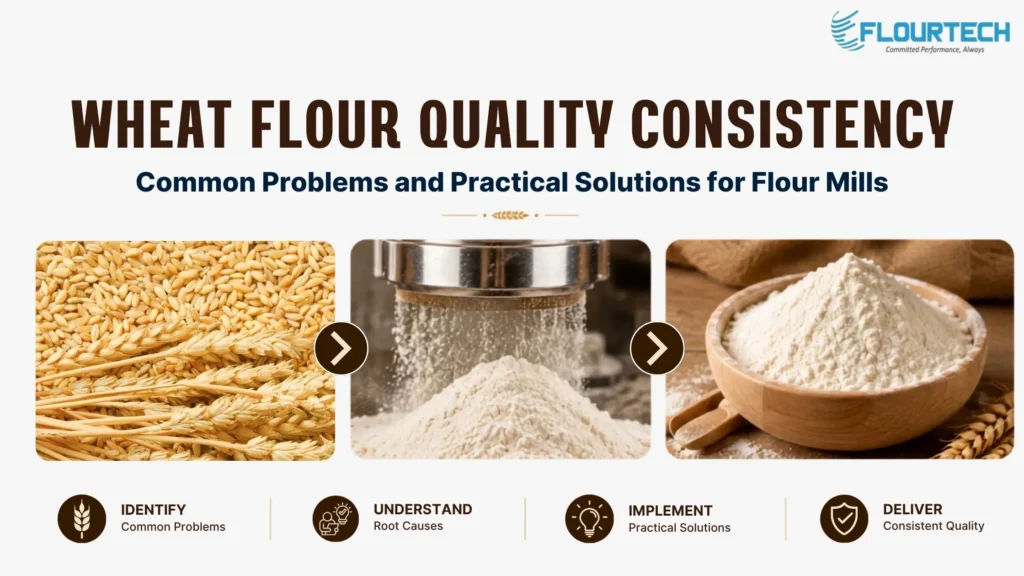
One of the most significant problems for flour mill owners is producing consistent wheat flour. If a customer buys flour today, they expect the same performance from the next delivery, whether it is used for making chapatti, bakery products, biscuits, noodles, or any other purpose.
However, it is not always possible to produce the same flour quality in each batch. There are common situations in many flour mills without changes in the milling process, variations in colour, moisture, particle size, water absorption, gluten performance, and extraction rate.
The reason is simple: there are several connected factors that affect the quality of flour. The quality of incoming wheat, conditioning practices, grinding settings, sifting efficiency, machine condition, and maintenance discipline these all affect the final product.
A successful flour mill business does not achieve consistency by focusing on only one machine or one process stage. It comes from controlling the complete milling operation.
What causes quality variation in wheat flour production?
The major reason behind inconsistent wheat flour quality is the natural variation of wheat and the small changes that occur inside a milling plant during continuous operation.
A typical flour milling process involves multiple stages:
Wheat Intake → Cleaning → Conditioning → Grinding → Sifting → Flour blending → Packaging
A change in any one of these stages can affect the final flour quality.
Some common causes include:
- Variation in wheat quality
- Improper moisture conditioning
- Changes in roller performance
- Incorrect machine settings
- Sifter efficiency problems
- Delayed maintenance
- Lack of regular quality monitoring
In many cases, the problem is not caused by a major equipment failure. It often begins with small process variations that gradually affect production results.
How does wheat quality affect flour consistency?
The journey of wheat quality consistency begins when it enters the mill.
Wheat is an agricultural product, so its properties naturally depend on its variety, growing area, harvest conditions, and storage conditions. The milling behaviour is greatly affected by variations in protein content, hardness, moisture, and kernel size.
For example, hard wheat generally needs different grinding conditions from soft wheat. Similarly, wheat with different moisture levels will behave differently during conditioning and separation.
This is why experienced millers do not depend only on purchase specifications. They also evaluate wheat quality through testing and develop suitable blending strategies before milling to avoid unnecessary adjustments during production.
Why is wheat conditioning important in flour milling?
Many flour quality problems actually begin before the wheat reaches the grinding section.
Conditioning, also known as tempering, prepares wheat for efficient milling by adding controlled moisture and allowing time for it to distribute evenly within the grain.
The objective is to make the bran flexible and the endosperm easier to separate.
When conditioning is not properly controlled, several problems may occur:
- Bran may break into smaller particles and mix with flour
- Flour colour may become darker
- Ash content may increase
- Extraction performance may fluctuate
- Flour quality may vary between batches
Every wheat variety responds differently to conditioning. The moisture addition and resting time must therefore be adjusted according to the wheat characteristics and milling requirements.
This is one area where process experience plays a major role.
How does a roller flour mill affect flour quality?
The roller flour mill is the heart of the milling operation. It is responsible for gradually reducing the wheat kernel and separating flour from bran through multiple grinding stages.
The performance of a roller flour mill machine directly affects flour characteristics.
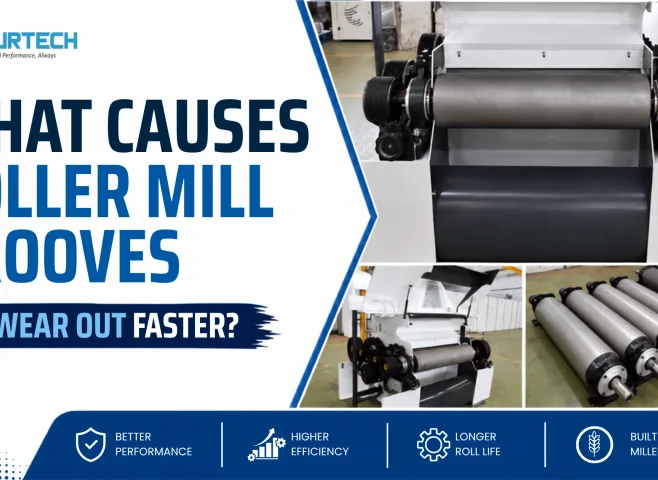
Over time, roller surfaces naturally wear because of continuous use in the mill. As the roll fluting becomes less effective, the grinding action changes.
The mill may start producing:
- More inconsistent particle sizes
- Lower extraction efficiency
- Higher starch damage
- Variations in flour performance
One challenge with roller wear is that it happens gradually. The machine continues running, but the quality of the output slowly changes.
Regular Inspection, roll adjustment, and timely re-fluting are important aspects of flour mill maintenance. Preventative action is used to ensure consistent production rather than responding to quality issues.
How do sifting and purification influence flour quality?
After the grinding process, the flour is sent to a sieving section, where it passes through plansifters and other separation machines that separate the good flour from unwanted particles, achieving a uniform particle size and clean flour.
A well-performing sifting system properly separates different flour streams.
However, problems can occur when:
- Sieve surfaces become blocked
- Screens lose tension
- Cleaning mechanisms fail
- Airflow conditions change
When this happens, flour streams may not separate properly, resulting in changes in texture, colour, and ash levels.
Regular inspection of sifters and purification systems helps maintain consistent flour quality throughout production.
Why is flour mill maintenance important for quality consistency?
Maintenance teams often focus on machine reliability, but it also plays a vital role in maintaining product quality.
A flour mill operates continuously, and components experience gradual wear. Rollers, bearings, sifters, conveyors, elevators, and pneumatic systems all require regular attention.
A machine does not always need to stop working before it affects quality.
Small changes in equipment performance can influence:
- Grinding efficiency
- Product uniformity
- Energy consumption
- Extraction rate
A planned flour mill maintenance program that helps to detect these changes early and ensure that the equipment operates near the design specifications.
What is the difference between wheat flour, atta, and maida?
Many people and even new businesses that are entering the milling industry often wonder, “Is wheat flour maida?
The answer is no.
Wheat flour is a general term for flour produced from wheat grain. It includes products such as whole-wheat flour, also called atta, and refined wheat flour, also known as maida.
Maida is produced by removing bran and germ and using mainly the endosperm portion of wheat.
Whole Wheat Flour, on the other hand, is considered atta because it contains most parts of the wheat grain.
The difference between maida vs wheat flour depends mainly on the level of refining and the intended application.
| Product | Characteristics | Common Uses |
|---|---|---|
| Atta / Whole Wheat Flour | Contains bran, germ, and endosperm | Chapatti, Flatbreads |
| Maida | Refined wheat flour | Bakery products, biscuits, noodles, bread |
| Sooji | Coarse endosperm particles | Pasta, confectionery |
What should businesses consider when planning a flour mill plant?
For anyone planning a new flour mill business or expanding an existing plant, equipment selection has a long-term impact on product quality.
The cost of a project, including the fully automatic flour mill plant price or overall wheat flour processing plant project cost in India, depends on several factors such as:
- Production capacity
- Level of automation
- Cleaning system requirements
- Milling technology
- Quality control systems
- Maintenance requirements
Choosing experienced flour mill manufacturers, flour mill machinery manufacturers, and flour mill plant manufacturers helps ensure that the plant design matches production objectives and future growth plans.
Choose the best machines and support for your flour mill
A flour mill that focuses on consistency builds stronger customer relationships and operates more efficiently.
With extensive experience in milling technology and plant engineering, Flourtech Engineers is a leading manufacturer that supports flour manufacturers in improving their milling performance, optimizing plant operations, and developing reliable solutions for consistent flour production. Whether upgrading existing wheat cleaning and flour milling machines like a roller flour mill, destoner, etc., or planning a new flour mill plant, the right engineering approach helps to create stable quality and sustainable growth.
Our team will provide a customized flour mill plant cost based on your specific requirements and goals.