
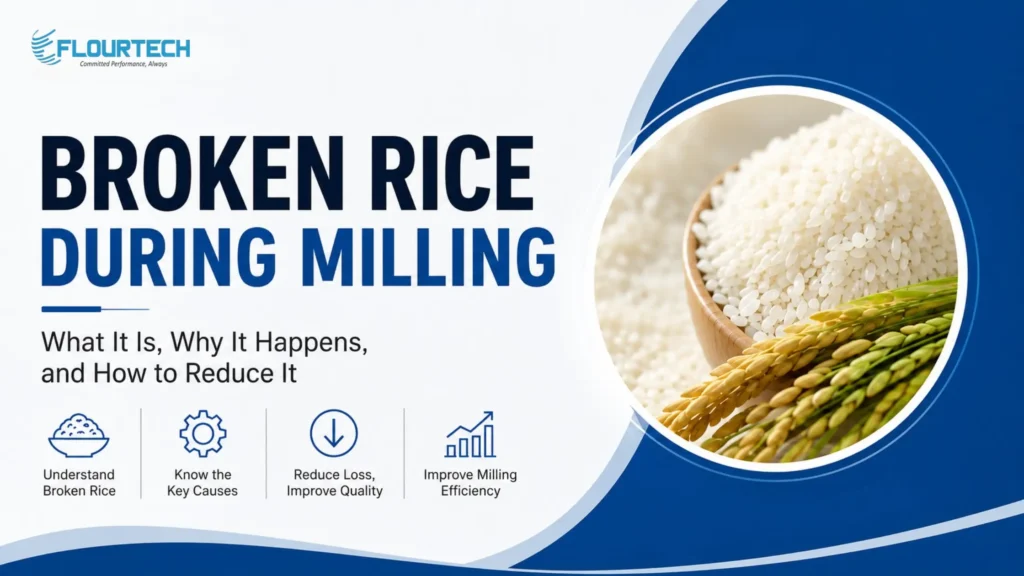
The quality of rice is an important factor in the success of each rice mill. The rice is always best when it is mostly unbroken and clean, whether sold in the local market or exported internationally. A higher percentage of whole rice not only improves the product quality but also increases its market value.
But the most common problem faced by most rice mills is broken rice during milling. A small amount of grain breakage is normal, but excessive broken rice affects head rice yield, profits, and customer satisfaction.
The good news is that the majority of grain breakage can be minimized. Through the knowledge of factors influencing the quality of rice in milling and proper processing, the miller can get better rice quality and recover more whole grains.
In this article, we will explore what broken rice is, why it breaks during milling, and practical steps to reduce grain breakage.
What Is Broken Rice?
Broken rice refers to rice grains that split or break into smaller pieces during milling. They are smaller than the whole grain, so they are removed during the grading process.
It’s important to note that broken rice is not damaged or spoiled rice. It has the same nutritional value as whole rice. The only difference is the size and look. Consumers generally prefer longer grains; broken rice is usually sold at a lower price, or it is used for products such as rice flour, breakfast cereals, brewing, pet food, and processed foods.
Every rice mill produces some broken rice during milling. While it is impossible to eliminate broken rice, the goal is to keep it to a minimum by following proper milling practices and using the right equipment.
Difference between Whole Rice and Broken Rice
The table below highlights the key differences between whole rice and broken rice in terms of quality, appearance, and market value.
| Feature | Whole Rice | Broken Rice |
|---|---|---|
| Grain Size | Full-length kernels | Broken or smaller pieces |
| Appearance | Uniform and attractive | Irregular in size |
| Market Value | Higher | Lower |
| Consumer Preference | High | Moderate |
| Common Uses | Household cooking, retail | Rice flour, brewing, processed foods, animal feed |
| Nutritional Value | High | Almost the same as whole rice |
Why Does Rice Break During Milling?
Rice grains look strong from the outside, but if not handled properly, they will crack very easily. In most cases, broken rice is not caused by a single problem. It typically happens due to several small problems during the milling process.
- Incorrect Moisture Content
Moisture is one of the most important factors that will impact rice quality. If paddy becomes too dry, it makes the grain brittle and prone to breaking during milling. However, when grains are too wet, they will be softer and may be damaged during processing.
Maintaining the correct moisture level before milling helps the grains remain strong and reduces unnecessary breakage. - Improper Drying
Drying paddy too quickly or unevenly often creates tiny internal cracks that cannot be seen with the naked eye. During milling, these hidden cracks become weak points, causing the grains to break.
Slow and uniform drying helps maintain grain strength and improves milling performance. - Poor-Quality Paddy
The quality of raw paddy directly affects the final milling result. Immature grains, insect-damaged paddy, or poorly stored paddy naturally have weaker kernels that are more likely to break during processing.
Always using clean, mature, and properly stored paddy gives better milling results. - Incorrect Machine Settings
Machine adjustments are important for each rice variety. The risk of grain breakage increases if the pressure is too high, the gap between the rollers is too small, or the operating speed is too high.
Regular inspection and proper machine calibration help achieve better milling quality. - Worn-Out Machine Parts
Machine parts, such as rubber rolls, screens, and whitening chambers, are subject to wear and tear. If these parts are not replaced on time, they exert uneven pressure on the grains, reducing milling efficiency.
Routine maintenance ensures the smooth operation of the equipment and protects the rice quality.
How to Reduce Broken Rice During Milling
Reducing broken rice starts with the paddy before it enters the milling machine. Good preparation, operation, and maintenance of the machines contribute to improved head rice recovery.
- Maintain the Right Moisture Level
Always check the moisture content before milling. Paddy with balanced moisture withstands milling pressure much better than grains that are either too dry or too wet.
Regular moisture testing helps maintain consistent rice quality throughout production. - Dry Paddy Properly
Drying should be slow and uniform. Avoid exposing paddy to excessive heat or uneven drying conditions, as these increase the risk of invisible grain cracks.
Proper drying also improves storage life and supports better milling performance. - Clean Paddy Before Milling
Dust, stones, straw, and other foreign materials should be removed before processing. Clean paddy flows more smoothly through the machines, reducing unnecessary stress on both the equipment and the grain.
Good cleaning also protects valuable machine components from damage. - Adjust the machines carefully
Machine pressure, feed rate, roller gap, and operating speed should match the type and condition of the paddy being processed.
Even small adjustments can significantly reduce grain breakage while improving overall milling efficiency. - Perform Regular Maintenance
Regular servicing helps machines operate consistently. Replacing worn parts before they fail prevents uneven grain handling and reduces unexpected production losses.
A well-maintained rice mill not only produces better-quality rice but also reduces downtime and maintenance costs.
Causes and Solutions of Broken Rice
The following table summarizes the common causes of broken rice and the practical solutions to reduce grain breakage.
| Cause of Broken Rice | Recommended Solution |
|---|---|
| Low or high moisture content | Maintain 13–14% moisture before milling |
| Uneven drying | Dry paddy slowly and uniformly |
| Poor-quality paddy | Use mature, clean, and properly stored paddy |
| Incorrect machine settings | Adjust pressure, speed, and roller gap properly |
| Worn-out machine parts | Perform regular inspections and replace damaged parts |
| Excessive whitening | Use balanced whitening settings |
| Poor grain handling | Handle paddy carefully during processing |
Ideal Moisture Content for Rice Milling
Among all the factors affecting broken rice, moisture content deserves special attention.
For most rice varieties, a moisture level of around 13–14% is generally considered suitable for milling. At this range, rice grains are strong enough to withstand mechanical pressure without becoming too brittle or too soft.
Moisture below this level often increases grain cracking, while higher moisture may affect milling efficiency and grain appearance.
Using a moisture meter before milling is a simple practice that helps maintain consistent product quality and improves head rice yield.
Rice Milling Machines That Help Reduce Broken Rice
Modern rice mills use several machines that work together to minimize grain damage throughout the process.
- Pre-Cleaner: A Pre-Cleaner Machine is used to remove dust, straw, stones, and other impurities before milling begins.
- Destoner: We are using a Destoner Machine that separates stones from paddy, protecting both the rice grains and milling equipment.
- Rubber Roll Sheller: Removes the husk gently. Proper roller adjustment is essential for minimizing grain breakage.
- Paddy Separator: We use a Paddy Separator to separate unhusked paddy from brown rice, preventing unnecessary reprocessing.
- Rice Whitener: Removes the bran layer. Correct pressure settings help achieve effective whitening without damaging the grains.
- Rice Polisher: Improves the appearance of rice while maintaining grain strength when operated correctly.
- Rice Grader: Separates whole rice from broken rice, ensuring a consistent final product.
Each machine contributes to better milling performance, and together they help increase the recovery of whole rice.
Rice Milling Machines and Their Functions
Each machine in the rice milling process has a specific role in protecting grain quality. The table below explains their functions and benefits:
| Machine | Primary Function | Benefit |
|---|---|---|
| Pre Cleaner | Removes dust and impurities | Protects machines and improves rice quality |
| Destoner | Removes stones | Prevents grain and machine damage |
| Rubber Roll Sheller | Removes husk | Minimizes grain breakage |
| Paddy Separator | Separates unhusked paddy | Reduces unnecessary reprocessing |
| Rice Whitener | Removes the bran layer | Produces quality white rice |
| Rice Polisher | Improves rice appearance | Enhances market value |
| Rice Grader | Separates whole and broken rice | Ensures a consistent final product |
Benefits of Reducing Broken Rice
Reducing broken rice offers several advantages for rice mill owners.
- Higher head rice yields the same quantity of paddy.
- Better product appearance and improved rice quality.
- Higher market value because whole grains sell at better prices.
- Reduced wastage during milling.
- Greater customer satisfaction due to improved consistency.
- Better profitability through higher recovery and lower production losses.
Even small improvements in milling practices can create noticeable financial benefits over time.
Conclusion
Broken rice is one of the most common problems faced in rice milling. It is also one of the easiest problems to control when the right milling practices are followed. The quality of paddy, moisture management, drying, machine adjustment, and maintenance are significant factors that help to enhance the milling efficiency.
Rice millers should not focus on only one stage of the process but rather observe the entire milling process, from rice preparation to final grading. Making small improvements at any stage can significantly increase head rice production, product quality, minimize losses, and boost profit.
By adopting these best practices and using a reliable rice milling machine, mills can not only consistently produce high-quality rice but also ensure their customers’ expectations are met and continue to deliver superior business results.
Stop losing profit to broken rice.
Upgrade your milling efficiency with Flourtech Engineers’ high-performance processing solutions. Designed to maximize yield and boost your output quality.
Visit Us: https://flourtech.com/
Talk to an Expert: +91 8826731010 / +91 9663594709