
The demand for clean, safe, and high-quality pulses is growing rapidly across households, retail stores, and large food-processing industries. We see products like chana dal, moong dal, masoor dal, urad dal, and toor dal as everyday essential food items present in millions of kitchens. Behind this growth is a well-organized pulse processing plant, which converts raw harvested grains into polished market-ready dal with precision, efficiency, and consistency.
A modern pulse processing plant is not just a collection of machines. It is an integrated processing system with well-organized and connected stages. Every process from cleaning to packaging plays an important role in yield, product quality, and overall profitability.
What is a Pulse Processing Plant?
A pulse processing plant is a large-scale setup that converts raw pulses into clean, consumable dal suitable for consumption and packaging.
Raw pulses collected from farmers generally contain many types of impurities, such as dust, stones, husk, sand particles, incomplete grains, and broken seeds. All these impurities are sorted through multiple processing stages.
After processing, we get uniform high-quality pulses that are ready to sell in the market, which have better cooking results, improved appearance, and a higher commercial price.
The main motive of a pulse processing plant is simple but critical:
to increase yield, reduce grain breakage, and produce a uniform high-quality product.
Process Flow in Pulse Processing Plant
Pulse processing follows a systematic industrial flow:
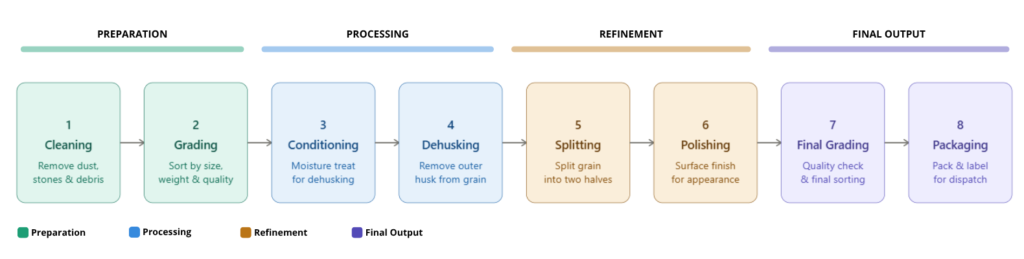
Cleaning → Grading → Conditioning → Dehusking → Splitting → Polishing → Final Grading → Packaging
Each stage is essential and directly affects efficiency and output quality.
1. Cleaning Section (Raw Material Preparation)
Cleaning is the first and most critical stage of pulse processing. Firstly, raw grains are thoroughly cleaned to remove impurities before entering the main processing line.
Main Machines Used in this Process:
- Vibro Separator
- Destoner Machine
- Magnetic Separator
- Air Aspirator System
Function:
In this stage, the machine removes dust, stones, sand particles, and metallic impurities from the grains. It ensures that only clean grains move forward, protecting the downstream machinery, and at the same time, it improves overall process efficiency.
2. Grading & Size Separation
After cleaning, pulses are passed through grading systems, where they are separated by size, shape, and thickness.
Machines Involved:
- Grading Machine
- Size Separator
- Multi-deck Sieve System
Function:
Proper grading ensures uniform processing in all further stages. It improves consistency during dehusking and splitting, resulting in better recovery and uniform dal output.
3. Conditioning (Pitting & Moisture Control)
In this stage, the outer surface of pulses is treated to improve husk removal efficiency.
A Pitting Machine creates micro-cracks on the grain surface, which helps loosen the outer husk. After pitting, conditioning is done using controlled moisture or resting time.
Major Machines Used:
- Pitting Machine / Emergy Roll Machine
- Moisture Conditioning System
- Controlled Resting Bins
Function:
This stage ensures that the husk becomes easier to remove without damaging the internal grain. That is what proper conditioning does; it also greatly improves processing performance and reduces breakage in later stages.
4. Dehusking Process
Dehusking is one of the most critical stages in pulse processing. At this point, the outer husk layer is removed from the grain.
Key Machines Used:
- Dehusking Machine
- Emery Roller Machine
Function:
These machines are carefully adjusted to remove husk efficiently while maintaining grain integrity. Proper calibration is essential to ensure high output and low breakage.
5. Splitting Process
After dehusking, grains are split into dal form using controlled mechanical pressure.
Machines Used:
- Dal Splitting Machine (Vertical Atta Chakki / Fatka Machine)
Function:
The grains are split into uniform halves. Depending on the grain type, multiple passes may be required to achieve proper splitting. This stage determines the final structure, appearance, and commercial quality of dal.
6. Polishing Process
Polishing enhances the visual appearance and market acceptability of dal.
Machines Used:
- Dry Polisher
- Water Polisher
- Oil Polisher (where applicable)
Function:
This stage enhances the shine and smoothness of dal. However, modern plants maintain controlled polishing to avoid over-processing, which can affect nutritional value and grain strength.
7. Final Grading & Packaging
In the final stage, the machine regrades the processed dal to separate whole grains, broken pieces, and fine particles before packaging.
Machines Used:
- Final Grader
- Colour Sortex Machine
- Packaging Machine
- Weighing & Sealing System
Function:
This ensures that only uniform, quality-checked pulses reach packaging. Proper sealing and weighing ensure product safety, longer shelf life, and good market presentation.
Key Benefits of Modern Pulse Processing Plant
A well-designed pulse processing system offers significant industrial advantages:
- Higher processing efficiency
- Improved dal recovery rate
- Reduced grain breakage
- Better product uniformity
- Lower operational losses
- Consistent export-quality output
Moreover, Modern automation systems also ensure better control over moisture, machine load, and product consistency.
Conclusion
A pulse processing plant is the backbone of the dal milling industry. It converts raw agricultural inputs into clean, ready-to-eat food products through a structured, controlled industrial process.
At each stage, from cleaning to packaging, quality is put forward, which in turn affects the yield and profit.
As the world demand for high-quality pulses grows, we see that modern automated dal milling systems are not a choice but a requirement for achieving efficiency, consistency, and long-term industrial growth.
Ready to Start Your Own Dal Milling Business?
Upgrade to a high-performance Pulse Processing Plant and maximize yield, quality & profits with advanced automation solutions. Contact Flourtech Engineers today for expert guidance and customized plant setup!
Our Website: www.flourtech.com
Contact Number: +91 8826731010
Frequently Asked Questions
Ans – A pulse processing plant is an industrial setup used to clean, grade, dehusk, split, polish, and pack pulses such as dal, lentils, chickpeas, peas, and beans. These plants help improve product quality, reduce wastage, and increase production efficiency.
Ans – A pulse processing plant works through multiple stages, including cleaning, destoning, grading, dehusking, splitting, polishing, and packaging. Each process ensures high-quality, impurity-free pulses for commercial use.
Ans – Pulse processing plants mainly process raw pulses such as chana (gram), tur (arhar), moong, urad, masoor, and peas, which are cleaned and processed into finished dal products.
Ans – Common machines include cleaners, destoners, graders, pitting machines, dehuskers, splitters, polishers, elevators, conveyors, and packaging machines.
Ans – Pulse processing plants come in different capacities, from small units processing 1–2 tons per hour to large industrial plants handling 10+ tons per hour depending on business requirements.
Ans – A dal mill mainly focuses on splitting pulses into dal, while a pulse processing plant includes complete processing such as cleaning, grading, polishing, sorting, and packaging for final market-ready products.
Ans – Pulse processing plants come in different capacities, from small units processing 1–2 tons per hour to large industrial plants handling 10+ tons per hour, depending on business requirements.
Ans – Yes, pulse processing plants are available for all scales of business:
- Small Scale: Low investment, compact space, suitable for startups and local mills
- Medium Scale: Moderate investment with higher efficiency and semi-automation
- Large Scale: Fully automated systems with high output and industrial production capacity
Ans – Automated plants improve efficiency, reduce labor costs, ensure consistent quality, minimize grain breakage, and increase overall production speed.
Ans – The cost depends on capacity, automation level, and machinery type. Small-scale plants require lower investment, while large-scale automated plants need higher capital but offer better long-term returns.
Ans – Yes, pulse processing is a profitable business due to high and continuous demand for pulses in both domestic and export markets. Proper setup and efficient machinery can ensure strong profit margins.
Ans – You should consider production capacity, automation level, energy efficiency, machine quality, maintenance support, and future expansion plans before selecting a plant.
Ans – Raw material quality, moisture level, machine settings, operator skill, and automation level significantly affect overall processing efficiency and output quality.
Ans – Pulse processing improves product quality, increases shelf life, removes impurities, enhances appearance, and ensures safe and hygienic food products for consumers.
Ans – The pulse processing industry is growing rapidly due to rising demand for protein-rich diets, packaged food products, and advanced processing technologies worldwide.
Ans – The top pulse producing states in India are:
- Madhya Pradesh – Largest producer of pulses, especially chana and tur
- Rajasthan – Major producer of moong, urad, and gram
- Maharashtra – Strong production of tur (arhar) and other pulses
- Uttar Pradesh – Produces masoor, gram, and multiple pulses
- Karnataka – Important contributor of tur and other pulse crops